Complete Guide to Penetration Testing for Cloud, Web, Mobile, and Network Environments
Why Modern Penetration Testing Needs a Broader Lens
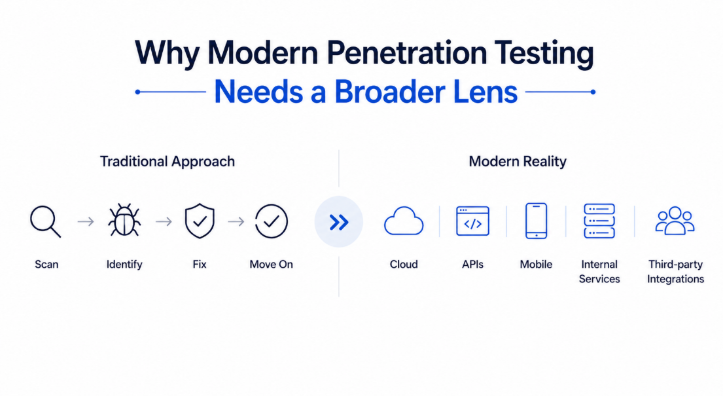
Penetration testing has traditionally been approached as a technical exercise scan system, identify vulnerabilities, fix critical issues, and move on. For many organizations, this cycle repeats every year, often driven by compliance requirements. But the way modern systems are built has changed fundamentally. Applications are no longer standalone. They are part of a larger ecosystem that includes cloud infrastructure, APIs, mobile interfaces, internal services, and third-party integrations. These components interact constantly, share trust, and exchange data across boundaries that are no longer clearly defined. This shift has changed how attacks happen. Breaches today are rarely the result of a single critical vulnerability. Instead, they occur because attackers can move through systems, chaining together small weaknesses, misconfigurations, and trust assumptions. That is why penetration testing, when done effectively, is no longer about identifying isolated issues. It is about understanding how access flows across cloud, web, mobile, and network environments and what becomes reachable when one part of the system is accessed.
What Penetration Testing Really Means Today
At its core, penetration testing is a controlled attempt to simulate how an attacker would interact with your environment. But the difference between a basic test and an effective one lies in what is being validated.
A traditional approach focuses on:
These are necessary, but not sufficient.
A modern approach focuses on:
This shift from finding vulnerabilities to validating reachability is what defines effective penetration testing today.
Cloud Penetration Testing: Beyond Misconfigurations
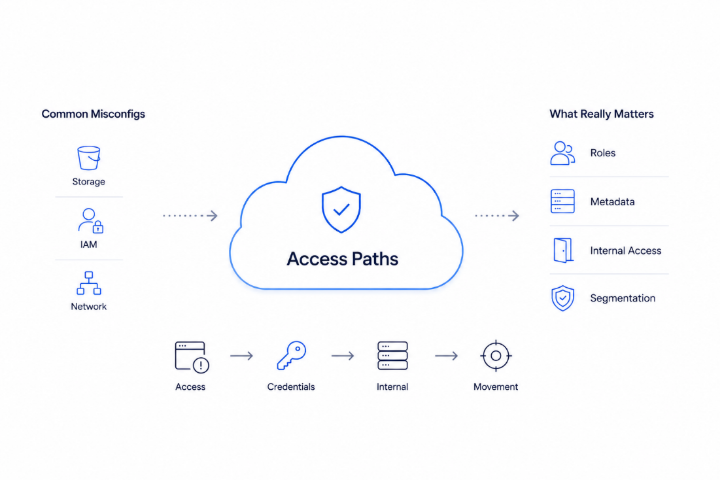
Cloud environments are often perceived as secure by design. Major cloud providers offer robust infrastructure security, and many organizations assume that using cloud services automatically reduces risk. Cloud security depends heavily on how services are configured and how identities are managed.
What Needs to Be Tested
Cloud penetration testing should go beyond checking for:
It should evaluate:
Real-World Example
In several cloud breaches, attackers did not exploit a critical vulnerability. Instead, they accessed an exposed service that allowed them to retrieve IAM credentials. Those credentials were then used to access internal resources, including databases and storage systems. Individually, each configuration may have seemed acceptable. But together, they created a path that allowed lateral movement within the cloud environment.
Web Application Penetration Testing: Beyond Input Validation
Web applications remain one of the most common entry points for attackers. Traditional testing focuses on issues like:
While these are important, modern web applications rely heavily on APIs and backend services, which introduce additional risks.
What Needs to Be Tested
Effective web application testing should validate:
Real-World Example
In one case, a web application had strong input validation and no obvious vulnerabilities. However, its API allowed users to access data by modifying request parameters. The system assumed that users would only request their own data, but it did not enforce that restriction properly. This was not a classic vulnerability.it was a business logic flaw. Yet it allowed attackers to access sensitive data from other users.
Mobile Application Penetration Testing: The Gateway to Backend Systems
Mobile applications are often treated as standalone systems, with testing focused on:
But mobile apps are rarely the target themselves. They are entry points into backend systems.
What Needs to Be Tested
Mobile penetration testing should evaluate:
Real-World Example
A mobile banking application enforced strict controls within the app interface. Users could not perform certain actions without proper authorization. However, the backend API did not enforce the same restrictions. By intercepting and modifying API requests, attackers were able to perform actions that were not allowed through the app. The mobile app was secure. The backend was not.
Network Penetration Testing: Testing Assumptions About Isolation
Network security has traditionally relied on segmentation separating systems into zones and controlling access between them. But modern environments often blur these boundaries.
What Needs to Be Tested
Network penetration testing should validate:
Real-World Example
In a corporate network, internal systems were assumed to be secure because they were not exposed to the internet. However, a web application hosted externally had access to those internal systems. By compromising the web application, attackers were able to move into the internal network, bypassing traditional segmentation controls. The network was segmented. But it was still reachable.
API Security Testing: The Hidden Layer
APIs are the backbone of modern applications. They connect web, mobile, and cloud components, enabling functionality across systems. But they also introduce complex trust relationships.
What Needs to Be Tested
API security testing should evaluate:
Real-World Example
An API validated authentication tokens but did not verify where the request originated from. As a result, tokens issued for one service could be used to access another. This created a scenario where attackers could reuse tokens to move across systems, even without exploiting a traditional vulnerability.
Third-Party and Integration Risk: Expanding the Attack Surface
Most organizations rely on external services for critical functions:
These integrations extend the system’s capabilities but also its attack surface.
What Needs to Be Tested
Penetration testing should validate:
Real-World Example
In several incidents, attackers gained access to an organization’s systems through a third-party vendor. The vendor’s credentials were compromised, and because they had trusted access, attackers were able to move into the primary environment. The organization itself was not directly compromised. The trust relationship was.
Why Testing Each Layer Separately Is No Longer Enough
One of the biggest challenges in penetration testing today is fragmentation.
Different teams handle different areas:
Each team may conduct its own testing, but these efforts are rarely integrated.
The result is a fragmented view of security. But attackers do not operate in silos. They move across systems, following the paths that exist between them. Effective penetration testing must reflect this reality by evaluating the environment as a connected system, not a collection of individual components.
What Organizations Should Expect from Modern Penetration Testing
A meaningful penetration test should not just produce a list of vulnerabilities. It should provide insight into:
It should answer questions like:
These are the questions that define real security maturity.
Final Thought: Security Is About Movement, Not Just Weakness
Modern systems are complex, interconnected, and constantly evolving.
Controls may be in place. Configurations may be correct. Vulnerabilities may be fixed. But security does not fail because something is obviously broken. It fails because access moves in ways that were never fully understood or tested. Penetration testing, when done effectively, helps organizations see these paths before attackers do. Because in the end, security is not just about what is vulnerable. It is about what is reachable.
Frequently Asked Questions [FAQS]
1. What is penetration testing across cloud, web, mobile, and network environments?
Penetration testing across these environments involves simulating real-world attacks to evaluate how different systems interact and expose risk. Instead of testing each layer separately, it focuses on how access moves between cloud infrastructure, web applications, mobile interfaces, and internal networks to identify real attack paths.
2. How is penetration testing different from vulnerability assessment?
A vulnerability assessment identifies and lists known weaknesses in systems. Penetration testing goes further by actively exploiting those weaknesses to determine how they can be combined and what an attacker can achieve. It validates real-world risk rather than just reporting issues.
3. Why is it important to test cloud, web, mobile, and network together?
Modern systems are interconnected. A mobile app connects to APIs, which interact with cloud services and internal networks. Testing these layers separately misses how attackers move across them. Combined testing helps uncover hidden access paths, trust gaps, and indirect exposure.
4. What are the key areas covered in modern penetration testing?
Modern penetration testing typically includes:
The focus is on how these areas interact rather than treating them independently.
5. How often should an organization perform penetration testing?
Penetration testing should be conducted at least annually or after major changes such as:
However, in dynamic environments, continuous or periodic testing is recommended to account for evolving risks.

%20(1).png)
.png)

.png)