Cyberattacks Are Industry-Agnostic: They Succeed Because Systems Are More Connected Than Visible
Introduction: The Wrong Way We Frame Cyber Risk
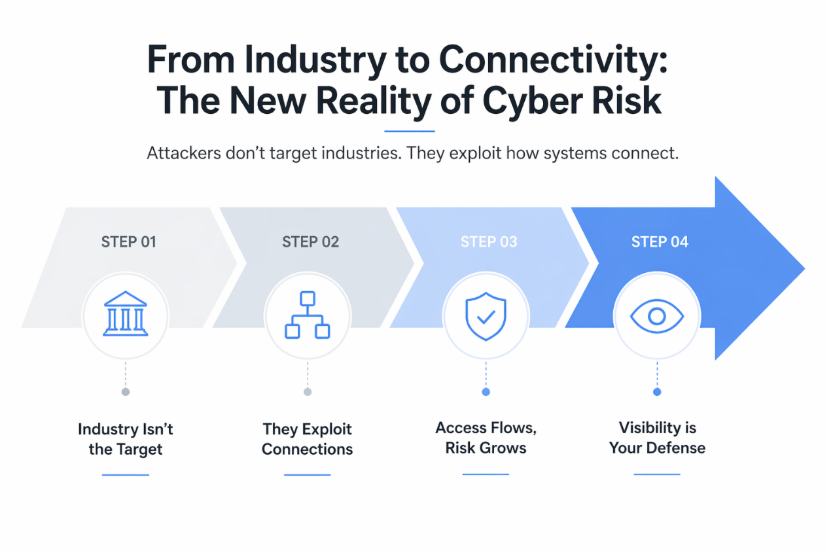
Cybersecurity discussions still tend to start with industries. When a breach happens, the immediate reaction is to classify it banking systems are targeted for financial gain, healthcare for patient data, SaaS platforms for scale and access. This framing feels logical, but it creates a false sense of understanding.
Because when you look closely at how real cyberattacks unfold, the industry itself is rarely the deciding factor. Attackers do not think in sectors. They think in systems.
What they exploit is not whether you are a bank, a hospital, or a SaaS company. What they exploit is how your systems are connected, how access flows between them, and how far that access can travel once it is established. That is the real shift most organizations have not fully internalized.
Cyber Risk Has Shifted from Industry to Connectivity
Traditional security models are built around classification assets, data sensitivity, compliance scope. These models assume that risk can be understood by looking at what exists within defined boundaries.
But modern environments do not operate within clean boundaries anymore.
Applications connect to third-party services. Internal systems expose APIs. Vendors integrate into core workflows. Identity becomes the bridge between everything. Over time, these connections form a network that is far more dynamic than any architecture diagram suggests.
Attackers operate inside this network.
They do not need to break systems when they can move through them. Their objective is not to exploit a single vulnerability but to identify how one point of access can lead to another, and then another, until they reach something of value. In that sense, risk is no longer tied to industry. It is tied to reachability.
What Modern Environments Quietly Become High-Risk
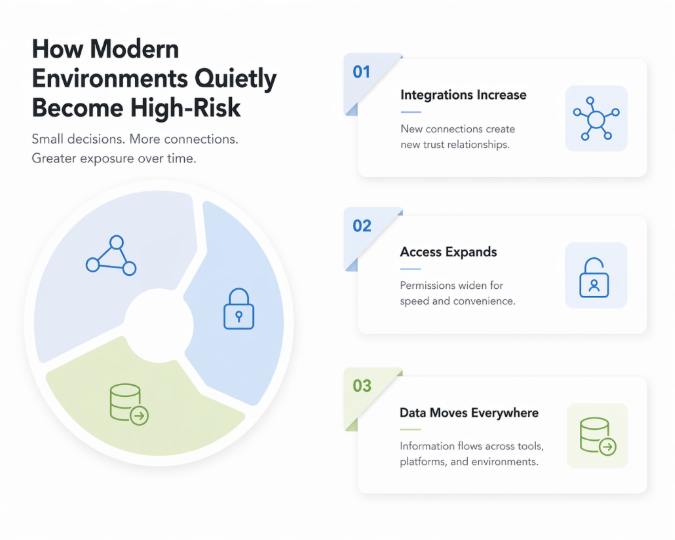
Most organizations do not design insecure systems. They evolve into them.
Growth demands speed, and speed introduces integration. A marketing platform needs data from a CRM. An analytics tool needs access to production logs. A vendor requires API connectivity to deliver a service. Each of these decisions is valid in isolation.
The problem is cumulative.
Every integration introduces a new trust relationship. Every trust relationship extends access. And over time, access begins to stretch far beyond its original intent.
Permissions follow a similar pattern. To avoid operational friction, access is often granted broadly service accounts receive extended privileges, APIs are given wide scopes, and temporary access is rarely rolled back. What starts as convenience gradually becomes exposure.
At the same time, data begins to move in ways that were never part of the original design. Internal datasets flow into third-party tools, logs are exported into external platforms, and dashboards aggregate information from multiple environments. Nothing appears broken, but the system is no longer contained. It is connected. And that connectivity changes everything.
The Visibility Problem: You Don’t See What Systems Have Become
Most organizations believe they understand their environment. They have architecture diagrams, asset inventories, and compliance reports that suggest control and visibility.
But these artifacts represent intention, not reality.
Systems evolve faster than they are documented. Integrations are added incrementally. Permissions change silently. Temporary fixes become permanent configurations. Over time, the actual behaviour of the system diverges from its documented design.
This creates a dangerous gap. The system you think you are securing is not the system that exists in practice. And attackers operate in that gap.
How Attacks Actually Work in Modern Systems
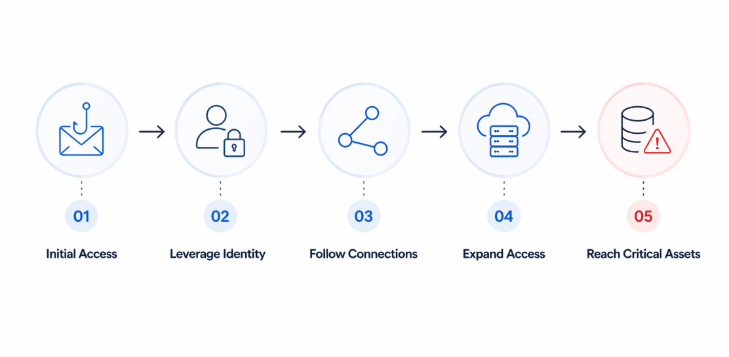
If you strip away industry context, most successful attacks follow a similar pattern.
It begins with a relatively simple entry point compromised credentials, a phishing email, an exposed API key, or a vulnerable endpoint. This initial access is rarely critical on its own.
The real impact comes from what happens next.
Attackers leverage identity. They use IAM roles, service accounts, tokens, and sessions to move within the environment. Instead of triggering alarms, they operate within expected behaviour because the access they use is legitimate. From there, they follow connections.
An internal service calls another system. A database is accessible through a shared credential. A SaaS platform exposes linked environments. Each step is enabled by trust that was established for operational reasons, not security considerations. Eventually, the attacker reaches sensitive data or critical systems. By that point, the breach is no longer about entry it is about exposure.
And that exposure was created long before the attack began.
Why Compliance Alone Cannot Address This Risk
Most organizations are not ignoring security. They invest in frameworks like ISO 27001, implement controls, and follow structured processes. These efforts are necessary, but they address only part of the problem. Compliance validates that controls exist and are documented. It ensures that policies are followed and that systems meet defined requirements at a point in time. What it does not validate is how those systems behave together.
It does not answer whether access can be chained across multiple systems. It does not reveal whether a compromised account can move laterally through integrations. It does not show how far an attacker can go once inside. This is not a failure of compliance. It is a limitation of what compliance is designed to do. And modern attacks operate entirely outside that scope.
Same Pattern, Different Industries
When breaches are analysed across sectors, a consistent pattern emerges.
In financial systems, integrations between payment platforms and third-party services create pathways that can be abused once access is obtained. In healthcare environments, interconnected patient systems and cloud platforms allow movement across datasets when segmentation is weak. In SaaS environments, shared infrastructure and identity misconfigurations can expose data across tenants. The industries differ. The underlying issue does not. In every case, the attack succeeds because systems are connected in ways that extend access beyond visibility.
Rethinking Security: From Protection to Reachability
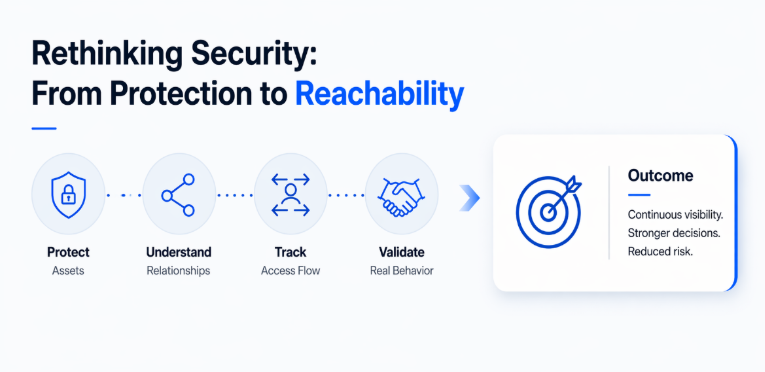
To address this reality, organizations need to rethink how they evaluate security.
The focus can no longer be limited to protecting individual assets. It needs to shift toward understanding relationships how systems interact, how access flows, and how trust is established across the environment. This means moving beyond static validation.
Security needs to account for behaviour. It needs to consider how systems respond under real-world conditions, not just whether controls are correctly configured. It requires continuous visibility into how connectivity evolves over time. Most importantly, it requires validation.
Not assumptions about how systems should behave, but evidence of how they behave when access is exercised.
Where Practical Testing Changes the Equation
This is where penetration testing becomes critical not as a checkbox activity, but to understand system behaviour. Effective testing does not stop at identifying vulnerabilities. It explores what those vulnerabilities enable. It examines whether access can be escalated, whether systems can be pivoted, and whether data can be reached through unintended paths.
It mirrors how attackers think. By following access across systems, testing reveals the true extent of reachability within an environment. It shows not just where weaknesses exist, but how they connect. And that is what defines real risk.
A Leadership Perspective: What Actually Matters
At a leadership level, the way cyber risk is framed needs to change.
The question is no longer whether controls are in place or whether systems are compliant. Those are baseline requirements.
The real question is what happens after an initial compromise.
How far can access travel?
Which systems become exposed?
What data can be reached as a result?
Because that is what determines business impact.
Risk is not defined by the number of vulnerabilities or the presence of controls. It is defined by the distance between entry and impact.
Final Thought: Nothing Looks Broken Until Everything Connects
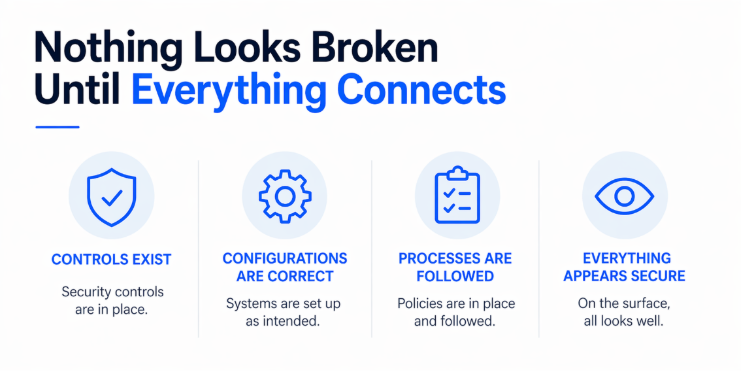
Modern systems rarely fail in obvious ways. Controls exist, configurations are correct, and processes are followed. On the surface, everything appears secure.
But beneath that surface, systems are becoming more connected, more dependent on trust, and more reachable over time. Nothing looks broken. Until everything connects. And when it does, the risk is no longer theoretical. It is already accessible.
Frequently Asked Questions
1.What does “industry-agnostic cyber risk” mean?
It means cyberattacks do not depend on the industry you operate in. They exploit how systems are connected and how access flows across them.
2.Why are integrations a major source of risk?
Integrations create trust relationships between systems. Over time, these relationships expand access and enable lateral movement if one system is compromised.
3.How do attackers move without triggering alerts?
They use legitimate access mechanisms such as APIs, tokens, and service accounts. Because the activity appears normal, it often bypasses traditional detection.
4.Why is visibility a bigger problem than vulnerabilities?
Because organizations often know where vulnerabilities exist, but they do not fully understand how systems are connected or what is reachable through those connections.

%20(1).png)
.png)

.png)