Enterprise Application Security: The Gap Between Security Controls and Real-World Exposure
Introduction: When “Secure” Doesn’t Mean Safe
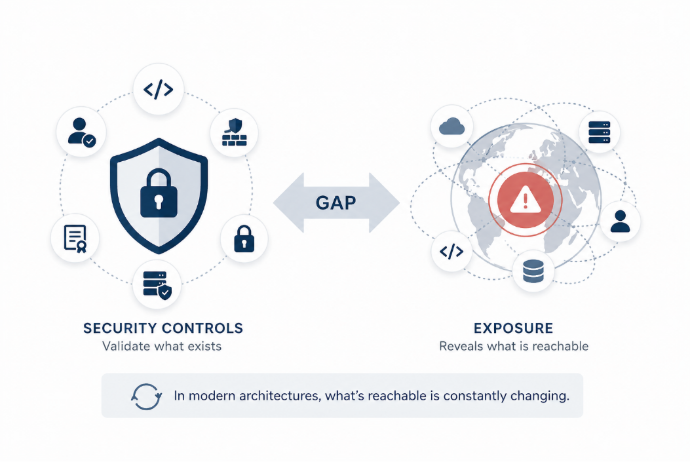
Most enterprise applications today are not insecure in the traditional sense.
They have:
On paper, everything looks strong.
But breaches continue to happen not because controls are missing, but because controls behave differently in real-world conditions.
That’s the gap:
Security controls validate what exists. Exposure reveals what is reachable.
And in modern architectures, what’s reachable is constantly changing.
The Problem: Security Is Built in Layers Attacks Move Across Them
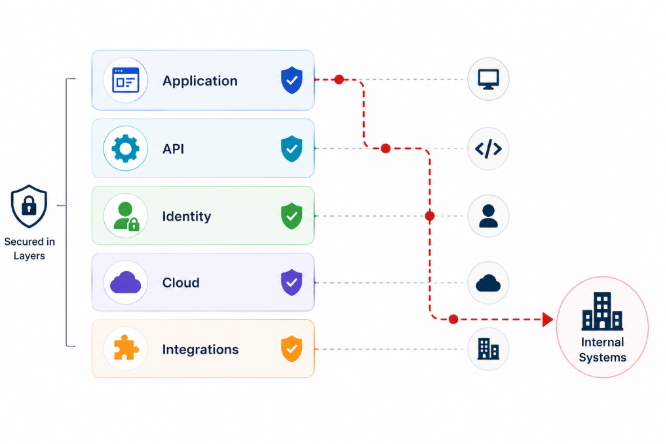
Enterprise application security is typically designed in layers:
Each layer is secured independently. But attackers don’t operate within layers. They move across them.
What this looks like in practice:
None of these are single vulnerabilities.
They are failures in how access flows across systems.
Why This Gap Is Growing in Modern Architectures
This isn’t a static problem. It’s accelerating.
Modern enterprise environments are:
Every new feature introduces:
And every one of these expands what can be reached.
The reality most teams miss:
Every new integration doesn’t just add functionality. It adds a new attack path. But these paths are rarely tested end-to-end.
Where Security Controls Break in Reality
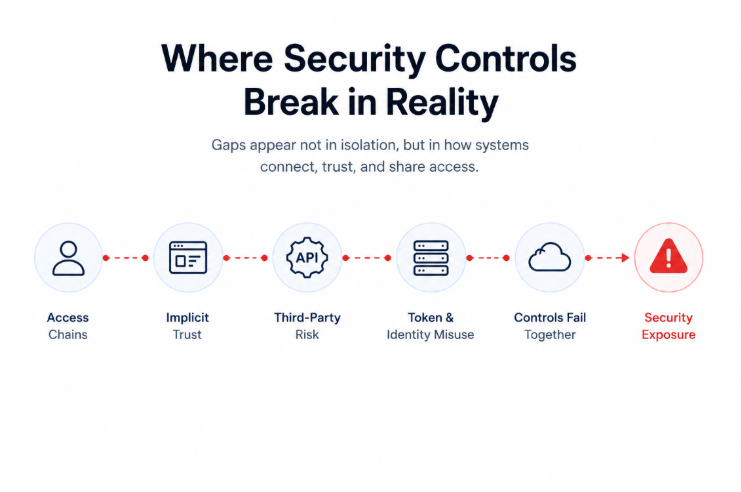
Let’s break down where this gap shows up.
1. Access Chains Across Systems
Access in enterprise applications is no longer linear.
It flows like this:
Each step may be secured.
But the chain itself is rarely validated.
What goes wrong:
👉 Result:
Attackers don’t break in.
They move through existing access paths.
2. Implicit Trust Between Services
Modern systems rely heavily on trust:
This trust is required for functionality. But it is rarely tested under adversarial conditions.
What goes wrong:
👉 Result:
Trust becomes the attack surface.
3. Third-Party and Integration Risk
Enterprise applications rarely operate in isolation.
They depend on:
These integrations extend capabilities but also extend exposure.
What goes wrong:
👉 Real-world pattern:
Organizations are breached not directly but through trusted integrations.
4. Token and Identity Misuse
Modern security is identity driven.
Access is controlled through:
These are powerful but also risky.
What goes wrong:
👉 Result: Access behaves differently than designed.
5. Controls That Work in Isolation but Fail Together
Most organizations validate controls individually:
But they don’t validate how these controls behave together.
The gap:
👉 Result: Security appears strong but is operationally weak.
Compliance vs Exposure: The Core Disconnect
Frameworks like ISO 27001 and regulatory requirements focus on:
These are necessary.
But they answer a different question:
“Do you have controls?”
They do not answer:
“Do those controls still hold under real-world conditions?”
The critical difference
Compliance Focus
Exposure Reality
Control exists
Control works under pressure
Policy defined
Behaviour validated
Access granted
Access contained
Systems secured
Systems not exploitable
What Enterprise Application Security Must Shift Towards
To close this gap, security must evolve.
From:
To:
What Effective Security Should Actually Validate
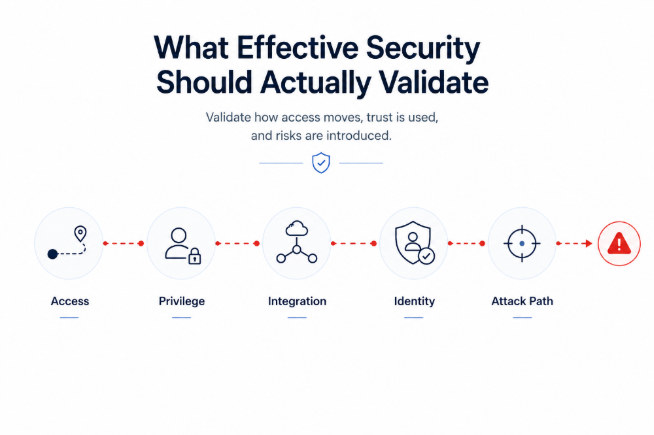
1. Access Path Validation
2. Privilege Escalation Scenarios
3. Integration Risk Testing
4. Identity and Token behaviour
5. Real Attack Path Simulation
The Strategic Shift: From Security-to-Security Assurance
This is where most organizations need to reposition. Security is not just about building controls. It’s about proving they hold. Not in theory. But in real conditions.
Final Thought: Security Doesn’t Fail Where Controls Are Missing
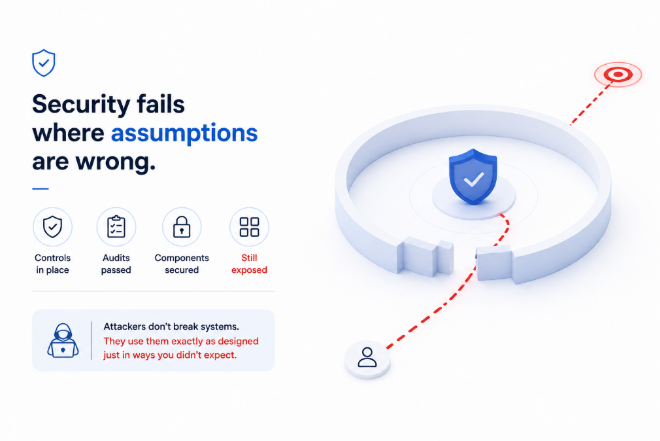
Security fails where assumptions are wrong.
You can:
And still be exposed.
Because:
Attackers don’t break systems.
They use them exactly as designed just in ways you didn’t expect.
Frequently asked questions [FAQs]
1. What is enterprise application security?
Enterprise application security focuses on protecting applications, APIs, and backend systems from unauthorized access, data breaches, and exploitation.
2. Why is traditional application security no longer enough?
Because modern systems are interconnected. Security failures now occur across systems, not within a single component.
3. What is the difference between security controls and exposure?
Security controls define protection mechanisms. Exposure reflects what is reachable and exploitable in real-world scenarios.
4. How do integrations increase security risk?
Each integration introduces new access paths and trust relationships, which can be exploited if not validated properly.
5. What should modern security testing focus on?
It should focus on:

%20(1).png)
.png)

.png)