The pitch deck has been rewritten. The financial model has been checked. The product demo is ready.
Then a prospective customer asks three straightforward questions:
The answers are scattered across engineering, operations and a few assumptions nobody has verified.
Cybersecurity for startups deserves attention before that conversation. It should begin when the business starts using important accounts, building software or handling information that would hurt to lose. Investment should grow as customer exposure, integrations and operational dependence increase.
A funding round is not the starting signal for basic protection.
For founders, the goal is a security programme proportionate to the business: clear priorities, working controls and evidence that supports what the company promises.
Pitch decks and financial models have visible deadlines. Security can feel less concrete until a customer questionnaire, incident or due-diligence request makes the missing work obvious. In a small team, everyone assumes someone else owns it.
The issue is often a planning gap.
A developer configures the cloud. A founder manages billing. A contractor has repository access. A sales lead makes a commitment about data protection.
Each decision looks small in isolation. Together, they determine how much access the business has granted and what it can actually support.
“We will fix it when we grow” also creates dependencies. Once customers rely on a product, changing authentication, separating customer data or removing broad administrative access can require careful migrations and coordination.
The answer is to make security part of the product and operating plan, with an accountable owner and enough time to address material weaknesses before they become urgent.
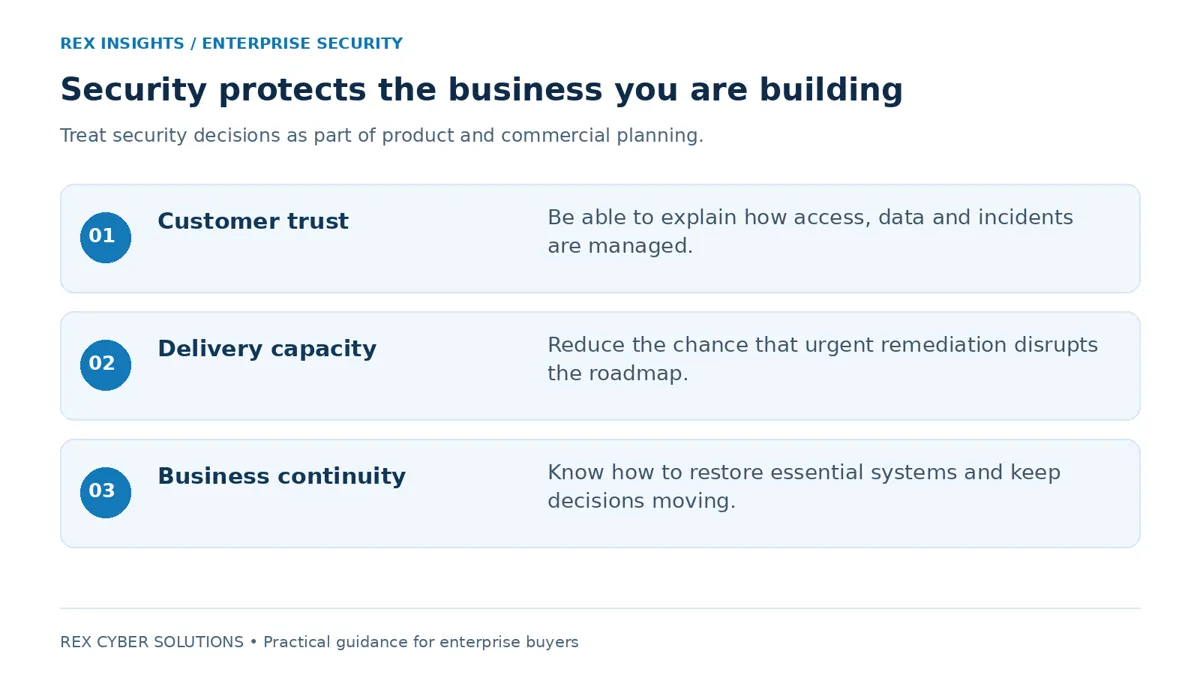
A startup can depend on a small number of systems: email, source code, cloud infrastructure, payment tools and customer records.
Losing access to one of them can affect delivery, collections or communication even if no customer data is stolen.
Ask a concrete question: If the main administrator account were compromised today, could the team regain control and restore essential work?
The answer matters as much as the next feature release.
Enterprise customers may require evidence of access controls, security testing, recovery procedures or independent assurance. If those requirements arrive late, your team may need to remediate gaps while sales waits for approval.
Good preparation cannot guarantee a deal, but it gives the buyer a clearer basis for assessing your service. It also helps sales avoid promising protections or timelines that engineering cannot deliver.
During investor or partner diligence, security questions may expose unclear ownership, sensitive data in unexpected places or dependence on one person’s account.
These are business risks that deserve a plan, whether or not a particular investor asks about them.
Protect email, domain registration, repositories, cloud administration and finance systems as soon as they are created.
Establish company-controlled ownership and recovery arrangements. A founder’s personal account should not become an undocumented dependency for the whole organisation.
A pilot is still a live risk when it contains confidential information.
Confirm what data is necessary, who can access it, where it is stored and how it will be removed. Prefer synthetic or appropriately de-identified data where feasible during testing.
Before inviting customers into a shared application, check that users cannot access another customer’s records. Include administrative tools, exports and background processes in that review—not just the visible screens.
Ask for security requirements early enough to plan. A buyer may require specific testing, contractual commitments or assurance documents. Confirm the exact scope and acceptance criteria with the appropriate buyer contact.
Do not wait until signature week to learn that a report, control or review is mandatory. Bring security and engineering into the discussion before committing to dates.
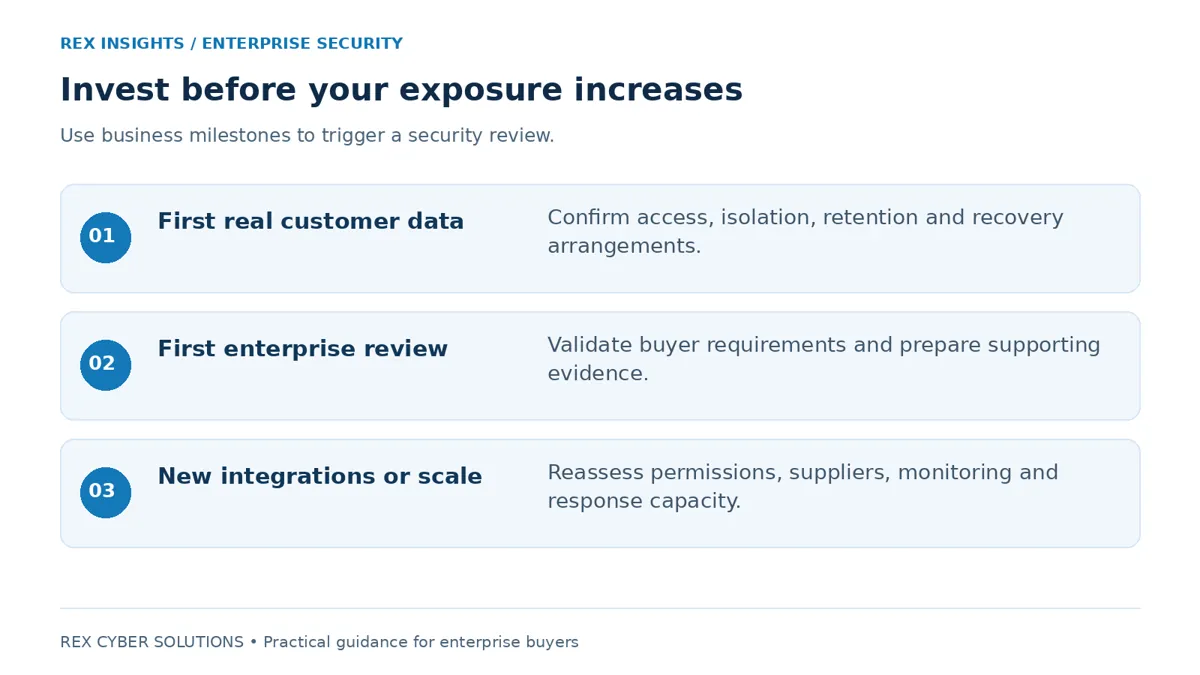
Revisit risk when adding a payment flow, AI feature, sensitive data category, contractor, cloud environment or integration.
More customers and broader permissions can change the impact of a mistake, even when headcount stays the same.
NIST’s small-business resources are designed for organisations with limited or no existing cybersecurity programme. They offer a way to begin managing risk without assuming the company already has a large security team. [1]
Maintain a practical inventory of essential systems, important data and responsible owners.
Include SaaS subscriptions and third-party integrations. Record which systems the business cannot operate without and where sensitive information is processed.
Enable multi-factor authentication, preferably phishing-resistant methods where supported, and use a password manager. NIST includes these among its recommended cybersecurity basics. [2]
Use individual accounts, limit administrative privileges and remove access promptly when a person leaves.
Keep emergency recovery access controlled and documented. Review service accounts and API tokens as well as employee accounts.
Review code changes, manage secrets outside source code and check dependencies and configurations. Separate development and production access.
Validate authorisation in the application and APIs, especially for customer records, exports and administrative functions.
Set rules for introducing new tools and services. Convenience should not mean giving an integration permanent access to everything.
Keep software updated and assign ownership for vulnerabilities. Prioritise based on exposure, exploitability and business impact.
A finding is not closed merely because a developer says a change has been deployed. Verify the result where appropriate.
Use independent penetration testing when the product’s risk or buyer requirements call for it. Agree a scope that reflects the real application, including APIs, roles and key workflows. Retest significant fixes and revisit testing after material changes.
Preparing to launch or share application testing evidence with a buyer? Explore Rex’s web application penetration testing.
For cloud permissions and configuration risks, explore Rex’s cloud penetration testing services.
Back up important data, protect the backups and test restoration. NIST explicitly recommends testing and protecting backups as part of basic security. [2]
Choose a realistic recovery scenario and run it. Record who performs the restoration, what access is required and whether the restored information is usable.
An untested backup can leave leadership with false confidence.
Write down who coordinates an incident, who can make containment decisions, how to reach external support and how customer communications will be handled.
NIST’s small-business guide recommends naming a responsible champion, contacts and reporting responsibilities, and practising the plan. [3]
Keep essential contact details accessible if normal systems are unavailable. Review notification commitments with the appropriate legal and business owners.
Practise one scenario, such as a compromised cloud administrator or exposed customer records, and fix the gaps the exercise reveals.
Security work manages risks to your systems, data and operations. Startup compliance work addresses applicable legal, contractual and assurance requirements.
The two support each other, but a policy folder or certificate does not establish that every technical weakness has been resolved.
Identify obligations that apply to your data and business model early. Separately, ask customers which assurance documents they need.
Do not assume every startup needs the same certification at the same stage, or that an assessment can be completed on a universal timeline.
If a qualified buyer requests a SOC 2 report or ISO 27001 certification, define the scope and preparation work before promising a delivery date. Keep the underlying controls operating while the assurance programme develops.
For a lean team, start with a prioritised gap assessment. The output should distinguish immediate risk reduction, buyer-specific requirements and longer-term improvements, with owners and realistic dates.
Security needs a named operational owner and a founder who can resolve resource decisions. A recurring review should focus on the risks and work that need leadership attention.
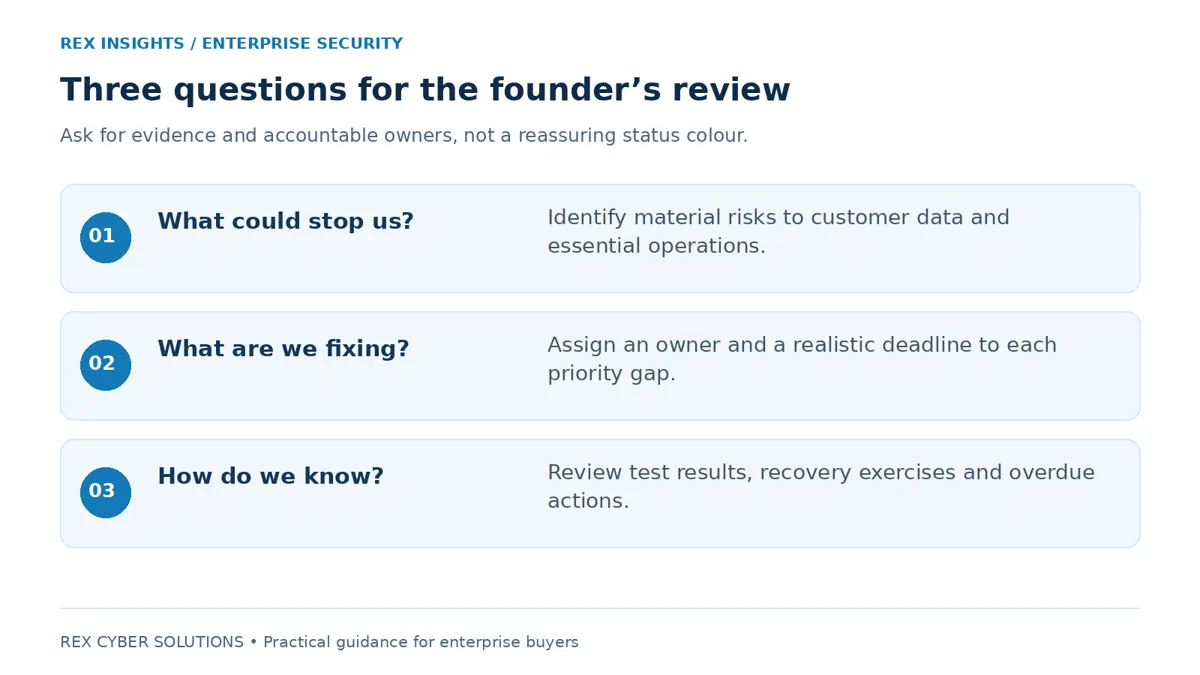
Budget for people’s time as well as tools and assessments. A platform may help collect evidence, but someone still needs to review access, resolve findings and make risk decisions.
External support can fill expertise gaps. Accountability for the company’s commitments stays with leadership.
Answer: It helps protect customer information, essential accounts and the ability to operate. It also supports credible security reviews and reduces the chance that urgent remediation disrupts product delivery or customer onboarding.
Answer: Begin with basic protection when setting up business accounts and systems. Strengthen controls before handling real customer data, launching important workflows or accepting enterprise commitments. Increase investment as exposure grows.
Answer: Not necessarily. It needs an accountable owner, appropriate expertise and enough capacity to maintain the controls its risks require. Specialist support can help where the internal team lacks experience.
Answer: Prepare and operate the controls that support your risks and required assurance scope. Choose a certification or report based on real customer and business needs. Documentation alone does not make the product secure.
Answer: It provides evidence about a defined scope at a particular time. Remediation, verification and ongoing security work remain necessary. Reassess after material changes and according to risk and customer requirements.
Answer: Identify critical accounts, systems and data, then review access, exposed services, important vulnerabilities and recovery capability. Use a focused gap assessment to turn findings into an owned, prioritised action plan.
A pitch explains where the company is going. Security preparation helps protect the accounts, data and operations needed to get there.
Give both a place in the plan before a customer or incident forces the decision.
Rex Cyber Solutions can help you understand application and cloud security gaps and plan relevant compliance preparation.
Bring your product architecture, current concerns and any customer questionnaire to a discovery call:
Book a discovery call with Rex Cyber Solutions