From Ports to Paths: Why ISNP Audits Miss Real Attack Movement
Introduction: The Illusion of Network Security
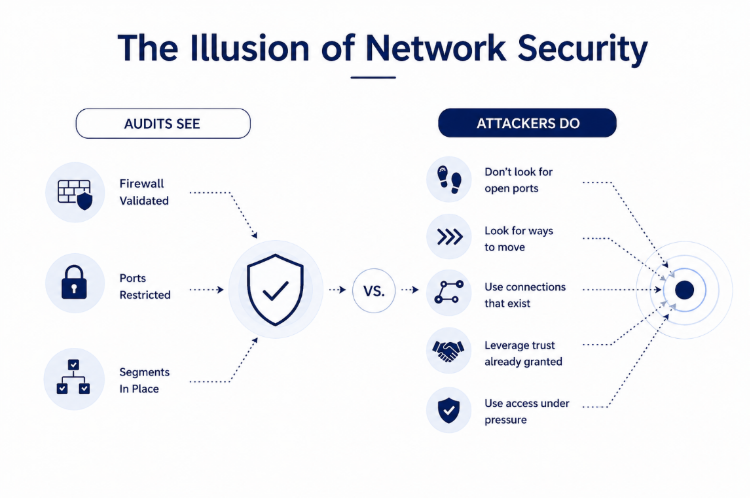
Most organizations walk out of an ISNP audit with confidence.
Firewall rules are validated. Ports are restricted. Segmentation policies are in place. On paper, the network looks controlled. And yet, breaches continue to happen in environments that are fully compliant. Because attackers do not approach your network the way audits do.
They do not look for “open ports.”
They look for valid ways to move.
They look for connections that already exist. They look for trust that is already granted. They look for access that behaves differently under pressure.
This is where traditional ISNP audits fall short.
They validate what is configured. Attackers exploit how it behaves. And in modern architectures, behaviour is defined not by ports but by paths.
What ISNP Audits Actually Validate
ISNP audits are built around a structured, control-driven approach.
They focus on validating whether key network security elements are correctly implemented:
These validations are necessary. But they operate under a critical assumption: That if every component is secure in isolation, the system is secure. That assumption no longer holds true. Because modern environments are not static infrastructures. They are dynamic, interconnected systems. And in such systems, risk does not emerge from a single misconfiguration. It emerges from how connections interact over time
Ports Are Static. Attack Paths Are Dynamic
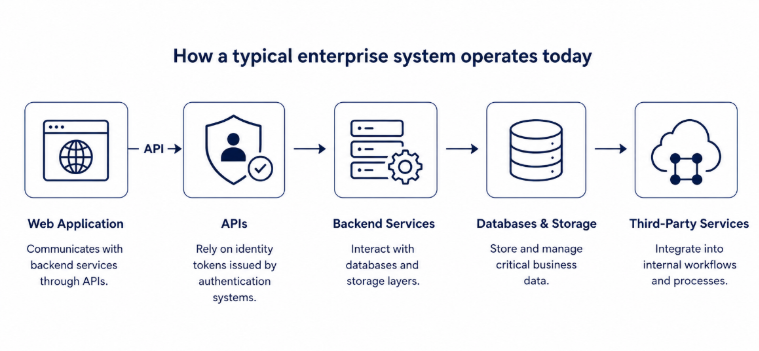
In traditional networks, controlling ports was a strong defensive measure. But today’s environments are fundamentally different.
Applications are distributed. Services are interconnected. Access is mediated through APIs, tokens, and identities.
Consider how a typical enterprise system operates today:
Each of these interactions is legitimate. Each is required for business functionality. But together, they form something that ISNP audits rarely evaluate:
A connected path of access.
An attacker does not need to “break” a port. They only need to follow a path that already exists.
Where ISNP Audits Miss Real Attack Movement
1. Configuration Without Context
ISNP audits validate whether configurations are correct.
But they do not evaluate how those configurations behave when combined.
For example:
Individually, each control works. But when chained together, they may allow unintended access. Without contextual validation, these risks remain invisible.
2. No Simulation of Lateral Movement
Once an attacker gains a foothold, their goal is not to exploit another port.
It is to move.
This is lateral movement. And it is rarely tested in ISNP audits. Because audits validate boundaries.
Attackers exploit what happens inside them.
3. Implicit Trust Remains Unchallenged
Modern networks rely heavily on trust relationships:
This trust is necessary for performance and scalability. But it is rarely tested under adversarial conditions. An attacker does not need to bypass every control. They need to exploit one trusted relationship and then follow it.
4. Fragmented View of Security
In most organizations:
Each team performs its own validation. Each passes its own audit. But attackers do not operate within these boundaries. They move across layers seamlessly. ISNP audits rarely provide a unified view of how access flows across the entire environment.
Real-World Scenario: When Nothing Is Open, But Everything Is Reachable
Let’s consider a realistic scenario.
An organization has:
From an audit perspective, everything is secure.
Now consider an attacker:
At no point did the attacker:
They simply followed the system’s intended behaviour. The risk was not in a control failure. It was in how access was allowed to propagate.
From Port Validation to Path Validation
To address this gap, organizations need to rethink how ISNP audits are performed. The focus must shift from individual controls to connected behaviour.
Instead of asking:
“Are ports secure?”
The question becomes:
“What can be reached through valid access?”
What Modern ISNP Audits Should Include
1. Access Chain Mapping
Understanding how requests move across systems:
2. Lateral Movement Testing
Simulating how far an attacker can move:
3. Trust Boundary Validation
Identifying where implicit trust can be abused:
4. Integration Risk Testing
Evaluating how third-party and internal integrations behave:
5. Attack Path Mapping
Reconstructing realistic attack scenarios:
Why This Shift Matters for Leadership
For CXOs, CISOs, and decision-makers, this is not just a technical issue. It is a strategic one.
Because traditional metrics:
Do not reflect actual exposure.
What matters is:
Security is no longer about preventing access.
It is about understanding what access enables.
Final Thought: Nothing Looks Open Until Everything Connects
Modern networks are not obviously vulnerable.
They are well-configured.
Well-documented.
Fully compliant.
But they are also:
Nothing looks open. Until everything connects. And when it does, the risk is not theoretical. It is already reachable.
Frequently asked questions
1. What is lateral movement in network security?
Lateral movement refers to how an attacker moves from one system to another after gaining initial access.
Instead of exploiting new vulnerabilities, attackers:
This movement often happens within the network, where traditional controls are less restrictive.
2. How do attackers bypass firewall protections without exploiting open ports?
Attackers don’t always need open ports.
They can:
This allows them to move through the environment using existing functionality, not vulnerabilities.
3. What is attack path analysis, and why is it important?
Attack path analysis identifies how an attacker could move across systems by chaining together valid access points.
It helps organizations understand:
This provides a more realistic view of security than isolated control validation.
4. How can organizations improve ISNP audits to detect real risks?
To make ISNP audits more effective, organizations should include:
This shifts the focus from configuration validation to behaviour validation.
5. What role do APIs and integrations play in network security risk?
APIs and integrations are essential for modern systems but they also expand access.
They:
If not tested properly, they can create hidden pathways that attackers can exploit.
6. Why is trust a major risk factor in modern networks?
Modern systems depend on trust for performance and scalability.
But trust is rarely revalidated continuously.
For example:
Attackers exploit this trust to move without triggering traditional defences.

%20(1).png)
.png)

.png)