Multi-Tenant Risk: How Cyberattacks Exploit Trust in SaaS Architectures
Introduction
Software-as-a-Service (SaaS) has become the backbone of modern business operations. From customer relationship management to financial systems and internal collaboration tools, organizations today rely heavily on SaaS platforms to operate efficiently and scale quickly. This shift has enabled faster innovation, reduced infrastructure costs, and simplified global access.
But this convenience comes with a structural risk that most organizations do not fully understand multi-tenant exposure driven by trust relationships. Organizations are increasingly moving towards continuous security validation and SaaS risk assessment frameworks to understand real exposure beyond configurations.
In a multi-tenant SaaS architecture, multiple customers share the same application, infrastructure, and services. While data is logically separated, the underlying systems are deeply interconnected. Over time, these connections create invisible pathways that attackers increasingly exploit.
Cyberattacks are no longer about breaking into systems. They are about moving through them using trust that already exists.
What Is Multi-Tenant Architecture?
Multi-tenant architecture allows multiple organizations (tenants) to use the same SaaS application while keeping their data isolated at the logical level. This model is widely used because it enables efficiency, scalability, and centralized management.
In theory, each tenant operates independently. All tenants rely on shared components such as:
Security in this model depends on logical separation and controlled access, not physical isolation. This means that security is enforced through configurations, permissions, and trust relationships rather than hard boundaries.
And that’s where the complexity begins.
Where the Risk Actually Emerges
Most organizations believe cyber risk comes from vulnerabilities unpatched systems, exposed servers, or weak passwords. While those risks still exist, modern SaaS breaches often occur in environments that are fully patched and compliant. This is where real-world attack path validation and penetration testing become critical to identify how these connections behave under pressure.
👉 Link:
The real risk emerges from how systems evolve over time.
As organizations grow, they:
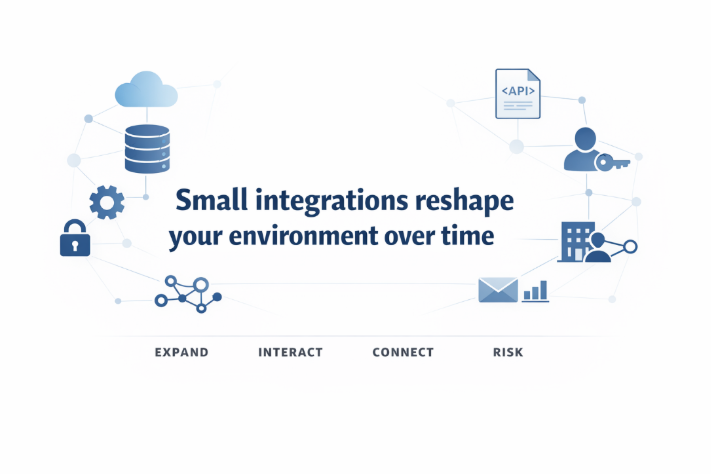
None of these changes seem risky on their own. Each decision is made for efficiency and business continuity. But over time, these small changes accumulate and reshape the system in ways that are not fully visible.
The result is an environment that is:
And that is exactly what attackers look for.
The Role of Trust in SaaS Security
Trust is the foundation of SaaS architectures. Systems trust each other to exchange data. APIs trust tokens to grant access. Applications trust identities to perform actions. Integrations trust external platforms to handle sensitive information.
This trust is necessary for systems to function.
But it is rarely revisited.
To avoid operational friction, organizations often:
Over time, trust expands beyond its original scope.
What started as controlled access becomes persistent, extended reachability.
And attackers don’t need to break trust they just need to use it differently.
How Cyberattacks Exploit Multi-Tenant SaaS Environments
Cyberattacks in SaaS environments are subtle. They do not always trigger alarms or break systems. Instead, they move through existing pathways.
Compromised Tenant as an Entry Point
In a multi-tenant system, a single compromised tenant can act as an entry point. Once attackers gain access to one account, they begin mapping accessible services and dependencies.
Even if strict data isolation exists, access to shared services or APIs can allow attackers to move laterally. The attack is no longer confined to one tenant it becomes a path exploration problem.
API Token Abuse
APIs are central to SaaS functionality. They enable integrations, automation, and data exchange. But they also introduce risk.
API tokens are often:
If a token is exposed, attackers can use it to access systems without triggering traditional authentication alerts. Since the token is valid, the system treats the activity as legitimate.
This allows attackers to:
All without “breaking in.” This is why modern organizations rely on API security testing and cloud penetration testing to validate how tokens and access paths can be exploited in real scenarios.
Third-Party Integration Risks
Modern SaaS ecosystems depend heavily on third-party integrations. From analytics tools to marketing platforms and financial systems, data constantly flows between services.
Each integration introduces a new layer of trust.
If one of these integrations is compromised, it can serve as a bridge into the core system. Attackers don’t need to target the primary SaaS platform directly they can enter through a less secure connected system.
Misconfigured Isolation
Multi-tenancy relies on logical isolation. But logical isolation is not always implemented perfectly.
Common issues include:
These issues don’t always result in immediate failures. Instead, they create subtle overlaps that attackers can exploit over time.
Real-World Example: Snowflake Data Breach (2024)
A notable example of SaaS-related exposure involved the Snowflake data breach in 2024.
Attackers gained access to multiple customer accounts using compromised credentials. These credentials were obtained from previous breaches and were not protected with multi-factor authentication (MFA).
What made this incident significant was not just the access but how it was used.
The systems were functioning as designed.
The breach occurred because:
This incident clearly demonstrates how trust, not vulnerability, becomes the attack surface in SaaS environments.
Why Traditional Security Approaches Fall Short
Most organizations rely on traditional security practices such as:
These approaches are important, but they focus on individual components, not system behaviour.
They answer questions like:
But they do not answer:
This creates a visibility gap.
And that gap is where modern SaaS attacks operate.
The Visibility Gap: What Organizations Don’t See
In most SaaS environments, organizations have visibility into:
But they lack visibility into:
This means organizations may believe they are secure because everything is configured correctly. But they do not know how those configurations behave when combined.
Security becomes assumption-based, not evidence-based.
Rethinking Security for Multi-Tenant SaaS
To address this risk, organizations need to shift how they approach security.
First, they need to move from configuration-based thinking to behaviour-based validation. It is no longer enough to know how systems are set up. You need to understand how they behave when used together.
Second, organizations must focus on reachability instead of permissions. Permissions describe what is allowed. Reachability reveals what is possible.
Third, integrations should be treated as attack surfaces, not just business enablers. Every connection expands the environment and introduces new pathways.
Finally, security must become continuous. SaaS environments are dynamic. New integrations, users, and data flows are added regularly. Security validation must keep pace with these changes.
Leadership Perspective: The Question That Matters
At a leadership level, the conversation around SaaS security needs to evolve.
The question is no longer:
“Are we secure?”
It is:
“If one part of our system is compromised, how far can an attacker go?”
Because in modern SaaS environments, risk is not defined by what is protected. It is defined by what is reachable.
Final Thought
Multi-tenant SaaS architectures are powerful, scalable, and efficient. But they are also deeply interconnected systems built on trust.
Most organizations secure individual components. But attackers exploit the connections between them.
Nothing looks broken. Until everything connects. And that is the moment where trust becomes exposure. If your organization operates on SaaS platforms, the real question is not whether controls exist but whether they work together under real conditions.
This is exactly what modern security validation is designed to uncover.
Frequently Asked Questions
1. What is multi-tenant risk in SaaS?
Multi-tenant risk refers to security exposure that arises when multiple customers share the same infrastructure, especially when trust relationships and access controls are not tightly managed.
2. How do cyberattacks exploit SaaS architectures?
Attackers exploit SaaS systems by leveraging existing access paths such as APIs, tokens, and integrations rather than breaking into systems directly.
3. Is multi-tenant architecture secure?
Yes, but only when isolation, access control, and trust relationships are continuously validated and properly managed.
4. What is the biggest risk in SaaS security?
The biggest risk is lack of visibility into how systems interact and how access propagates across services once a single-entry point is compromised.
5. How can organizations reduce SaaS security risks?
Organizations can reduce risk by validating real attack paths, limiting permissions, monitoring integrations, and continuously assessing system behaviours.

%20(1).png)
.png)

.png)