Pen testing vs. Audits: The Difference Between Checking Controls and Breaking Assumptions
Introduction: Most Organizations Confuse Validation with Assurance
Many organizations believe they are secure because they have:
On paper, everything looks correct.
But breaches don’t happen because controls are missing.
They happen because controls behave differently under real-world conditions.
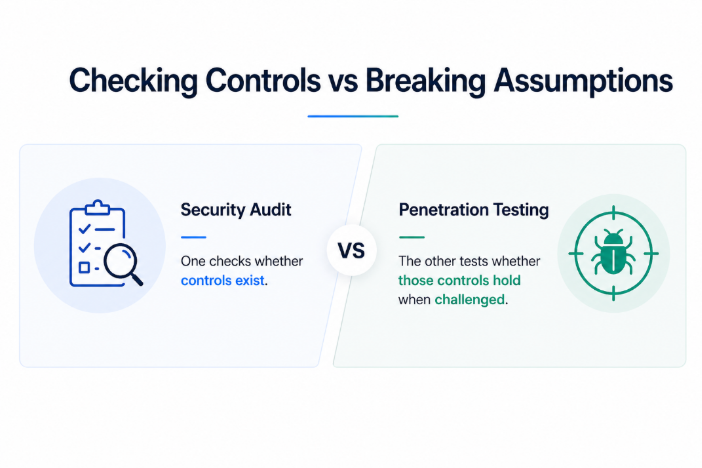
This is where the difference between security audits and penetration testing (pen testing) becomes critical.
One checks whether controls exist.
The other tests whether those controls hold when challenged.
What Is a Cybersecurity Audit?
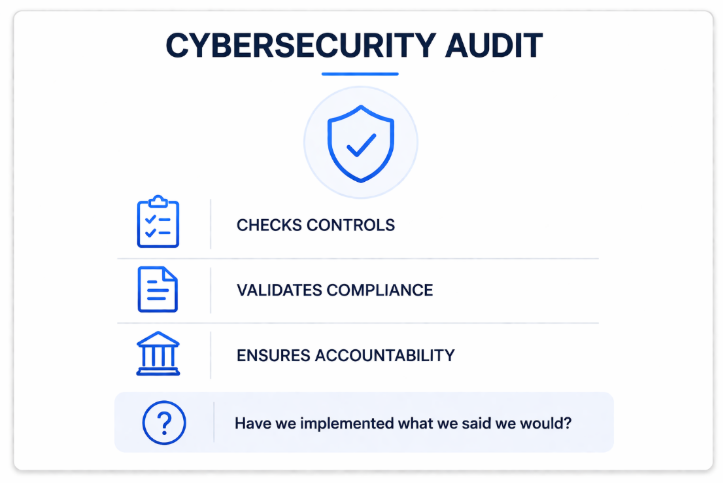
A cybersecurity audit is a structured evaluation of policies, controls, and processes.
It focuses on:
What Audits Validate
Where Audits Work Well
Audits are effective for:
They answer the question:
“Have we implemented what we said we would?”
Where Audits Fall Short
Audits are not designed to simulate adversarial behaviour.
They typically do not test:
In modern environments:
This creates relationships between systems that audits rarely validate.
Risk is no longer in individual controls.
It exists in how those controls interact.
What Is Penetration Testing (Pen testing)?
Penetration testing is a controlled simulation of real-world attacks.
It focuses on:
What Pen testing Actually Validates
Pen testing answers a different question:
👉 “If an attacker starts here, how far can they go?”
The Core Difference: Controls vs. Assumptions
This is where most organizations misunderstand the gap.
Security Audit
Penetration Testing
Validates controls
Challenges assumptions
Checks documentation
Simulates attacker behaviour
Focuses on compliance
Focuses on exploitability
Evaluates in isolation
Tests across systems
Snapshot in time
Real-world scenario
Why This Gap Is Increasing in Modern Architectures
Modern environments are:
This changes how risk behaves.
1. Access No Longer Stays in One System
A single request can move across:
2. Trust Is Distributed
Systems trust:
3. Behaviour Is Context-Dependent
The same input can produce:
👉 This means risk can exist without a visible vulnerability.
Real-World Scenario: Where Audits Pass and Attacks Still Succeed
Consider a typical SaaS environment:
Audit result: Compliant
But during pen testing:
No control was “missing.”
But access was expanded beyond intent.
This is the difference between checking controls and breaking assumptions.
Audit-Ready vs. Attack-Ready
Many organizations are audit ready.
Few are attack ready.
Audit-Ready Means:
Attack-Ready Means:
Why You Need Both (But Not in the Same Way)
This is not about choosing one over the other.
Both serve different purposes.
Use Audits For:
Use Pen testing for:
From Protection to Validation
Traditional security focuses on protection:
Modern security must focus on validation:
Because attackers don’t always break systems.
Final Thought: Security Doesn’t Fail Where Controls Are Missing
Security fails where assumptions are wrong.
You can:
And still be exposed.
Because:
Audits validate what exists.
Pen testing reveals what is reachable.
Frequently asked questions [FAQs]
1. What is the main difference between pen testing and a security audit?
A security audit checks whether controls and policies exist, while pen testing simulates attacks to test whether those controls can be bypassed or misused.
2. Is pen testing required if we already passed an audit?
Yes. Audits validate compliance, but pen testing validates real-world exploitability and attack paths.
3. How often should pen testing be performed?
At least annually, and after major changes such as new integrations, cloud migrations, or application updates.
4. Can audits detect attack paths?
No. Audits typically evaluate controls in isolation and do not simulate attacker behaviour across systems.
5. Which is more important: audit or pen testing?
Both are important. Audits ensure compliance; pen testing ensures real-world security.

%20(1).png)
.png)

.png)