Security Outlook 2026: AI Applications Are Changing Attack Paths VAPT Must Evolve
AI Has Not Just Increased Risk. It Has Changed How Risk Moves.
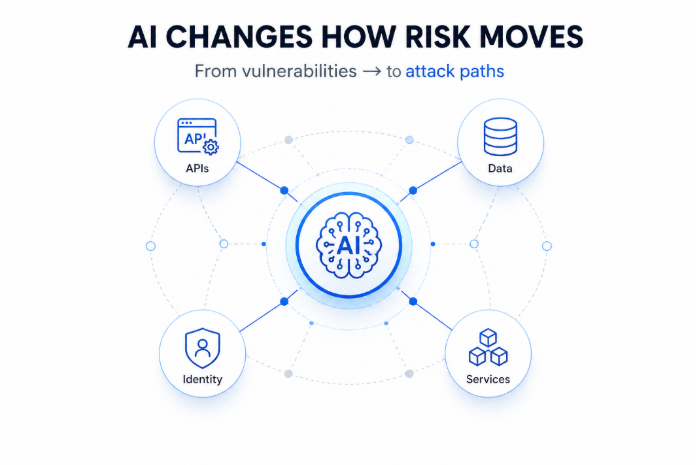
For years, security teams have evaluated risk as a collection of isolated weaknesses misconfigurations, vulnerabilities, missing patches, exposed endpoints.
That model no longer reflects reality. In AI-driven environments, risk is not static. It is dynamic, interconnected, and behaviour driven.
AI applications are not standalone systems. They are:
Every interaction expands what can be reached. Every integration changes how access behaves.
The result?
Attack paths are no longer obvious. They are constructed through normal system behaviour . And this is exactly where traditional VAPT begins to fail.
Why Traditional VAPT Models Are Breaking in AI-Driven Architectures
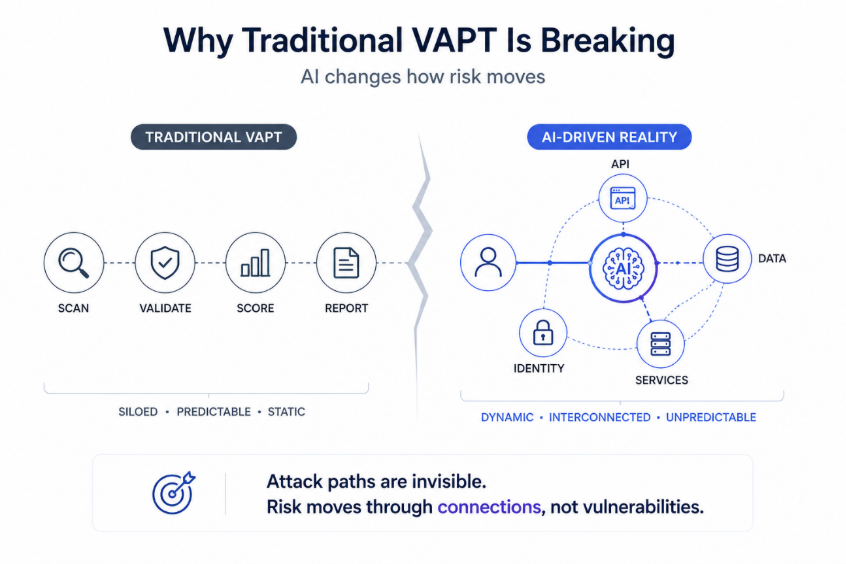
Most VAPT approaches still follow a familiar structure:
This model assumes that:
None of these assumptions hold true in AI environments.
Where the Gap Begins
AI applications introduce:
This means:
Traditional VAPT identifies what is weak. Modern attackers exploit what is connected.
The Shift from Vulnerabilities to Attack Paths
Security in 2026 is no longer about:
It is about:
Example: AI Application in a SaaS Environment
Consider a common enterprise AI setup:
Individually, everything is secured.
But now consider this:
No vulnerability. No misconfiguration.
But still:
An attack path exists.
AI Systems Introduce New Classes of Reachability
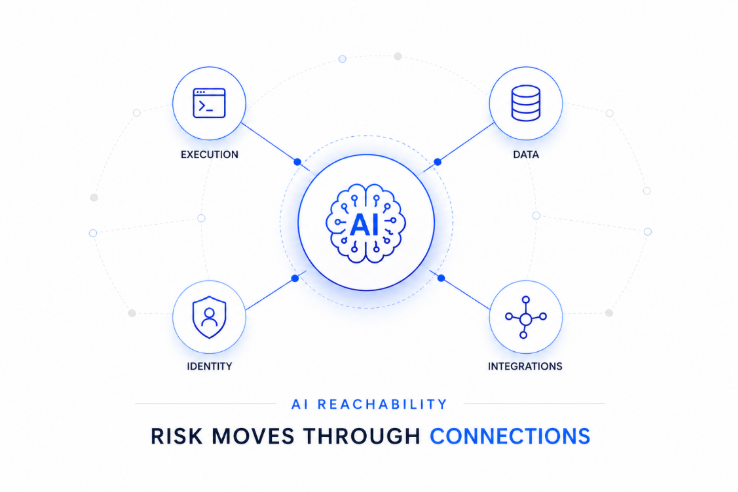
AI doesn’t just process data. It orchestrates access across systems.
This introduces new risk dimensions:
1. Indirect Execution Paths
AI models can trigger actions across systems without direct user interaction.
2. Context Leakage
Data used in one context may influence outputs in another.
3. Token and Identity Drift
AI services often operate with elevated privileges to function efficiently.
4. Integration Amplification
Each connected service increases possible paths of movement. The risk is no longer about entry points. It is about what can be reached after entry.
Why Compliance and Standard Testing Miss This Entirely
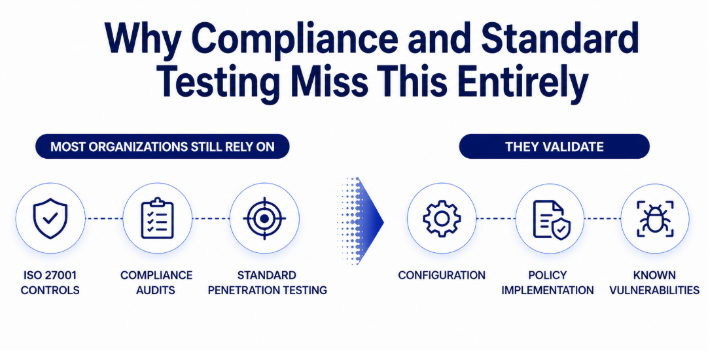
Most organizations still rely on:
These validate:
But they do not validate:
This creates a dangerous illusion:
Everything appears secure. Until systems start interacting.
Traditional VAPT vs AI-Aware VAPT
Here’s where the real difference becomes clear:
Traditional VAPT
Focuses on individual vulnerabilities
Tests systems in isolation
Validates known exploits
Relies on severity scoring (CVSS)
Limited to entry points
Static testing approach
Compliance-aligned
AI-Aware VAPT (2026 Reality)
Focuses on multi-step attack paths
Tests systems as interconnected flows
Simulates real-world attacker behaviour
Prioritizes reachability and impact
Extends across APIs, AI, and backend systems
Continuous and behaviour-driven validation
Risk-aligned
What Effective VAPT Must Validate in AI Environments
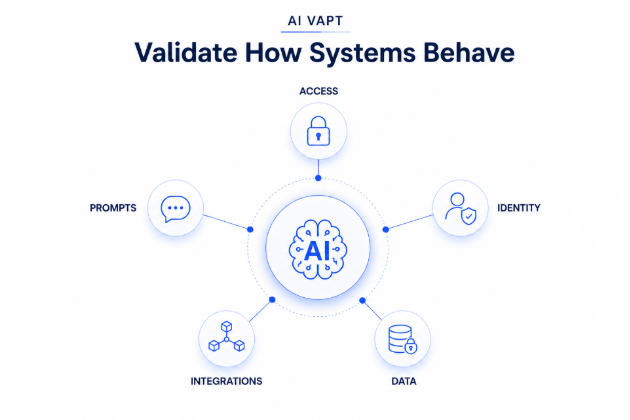
To remain relevant, VAPT must evolve from testing components to testing behaviour across systems.
1. Access Chain Mapping
Understanding how access flows:
👉 The goal:
Identify unintended access propagation
2. Prompt Manipulation Impact Testing
AI systems respond to inputs.
But inputs can be engineered.
Test:
3. Token and Identity Abuse Scenarios
AI systems often use:
Test:
4. Integration Path Exploitation
Every integration is a potential bridge.
Test:
5. Data Exposure Through Model Behaviour
AI models can:
Test:
Real-World Scenario: When Everything Works, But Still Fails
An enterprise deploys an AI assistant for internal operations.
It is:
During testing:
But under adversarial testing:
No system is broken. No control is missing.
But:
The system behaves in a way that exposes critical data. This is the new reality.
From Protection to Validation: The New Security Model
Security teams must shift from:
Protection mindset:
To:
Validation mindset:
Because attackers do not always break systems.
They:
Why This Gap Will Continue to Grow
This is not a temporary challenge.
It is accelerating because:
Every new AI integration:
And these paths are rarely tested end-to-end.
What This Means for CISOs and Security Leaders
This shift changes how security must be evaluated.
The key questions are no longer:
They are:
Because in 2026:
Risk is not what is documented. Risk is what is reachable.
Final Thought: AI Is Not Introducing New Risk. It Is Exposing Existing Blind Spots
AI did not create insecure systems.
It exposed:
Everything may be:
But still:
Highly connected systems create invisible attack paths.
Nothing looks broken. Until everything connects.
And when it does:
👉 The risk is not theoretical.
👉 It is already reachable.
Frequently Asked Questions (FAQs)
1. How is VAPT different for AI applications compared to traditional systems?
Traditional VAPT focuses on identifying vulnerabilities within defined system boundaries such as web apps, APIs, or networks.
AI application VAPT goes beyond this by evaluating:
The difference is critical:
👉 Traditional VAPT tests what is vulnerable
👉 AI VAPT tests what becomes reachable through behaviour
2. Can AI systems be exploited even if there are no vulnerabilities?
Yes and this is one of the most important shifts in modern security.
AI systems can be abused through:
In these cases:
But attackers can still:
👉 Access sensitive data
👉 Trigger unintended actions
👉 Move across systems
This is why security must move from vulnerability detection to attack path validation.
3. What are the biggest security risks introduced by AI-driven applications?
AI applications introduce new risk layers that are often not covered in traditional testing:
The biggest risk is not a single flaw.
👉 It is how multiple trusted components interact under real-world conditions
4. How should organizations update their VAPT strategy for AI systems in 2026?
Organizations need to shift from component-level testing to system-level validation.
An effective AI-aware VAPT strategy should include:
The goal is not just to find vulnerabilities.
👉 It is to understand how far an attacker can go once inside the system

%20(1).png)
.png)

.png)