SOC 2 vs ISO 27001: Which Standard Makes More Sense for Your Target Customers?
Your startup is preparing for enterprise sales. One prospect asks for a SOC 2 report. Another wants ISO 27001 certification. Your team has limited time and budget, and you need to decide which programme to start first.
Start with the evidence your target customers require. If qualified buyers make a particular report or certification a condition of purchase, that requirement should strongly influence the sequence. If either is acceptable, compare the scope, work needed and value across your pipeline before committing.
There is also an important distinction behind the search term “SOC 2 certification”: SOC 2 results in an independent assurance report, while ISO 27001 is a standard against which an information security management system can be certified. Treating them as interchangeable badges can lead to the wrong investment.
In this article
1. The difference between SOC 2 and ISO 27001
2. A side-by-side comparison
3. Which should your startup choose first?
4. How scope and timing change the decision
5. When pursuing both makes sense
6. Questions to ask before approving a budget
7. Frequently asked questions
8. Choose your next step with Rex
1. The difference between SOC 2 and ISO 27001
SOC 2 gives buyers an assurance report
SOC 2 examines controls over a service organisation’s defined system using AICPA Trust Services Criteria. The criteria cover security, availability, processing integrity, confidentiality and privacy; the engagement’s relevant categories and scope need to be agreed. A qualified independent CPA firm performs the examination. [1, 2]
Type 1 addresses control design at a specified date. Type 2 also evaluates operating effectiveness over a specified period and includes tests and results. Confirm which type the buyer needs: a Type 1 report does not provide the same evidence as Type 2. [2]
For a startup, the practical question is whether the report will cover the product, infrastructure and commitments that the customer is reviewing. Ask the buyer what it expects to see before arranging the engagement.
ISO 27001 certifies a management system within scope
ISO/IEC 27001:2022 specifies requirements for establishing, maintaining and improving an information security management system, or ISMS. It uses a risk-based approach to managing information security across people, processes and technology. Certification applies to the defined ISMS scope. [3]
External certification bodies issue certificates; ISO itself does not. Check the body’s accreditation and whether it meets your buyer’s expectations. Accreditation provides independent confirmation of the certification body’s competence. [4]
For a startup, the practical question is whether the proposed scope includes the activities and service the customer will rely on. A broad-sounding certificate is not a substitute for checking the actual scope statement.
2. A side-by-side comparison
Use this comparison to frame the discussion with your buyer and assessor. Neither option automatically satisfies every security review.
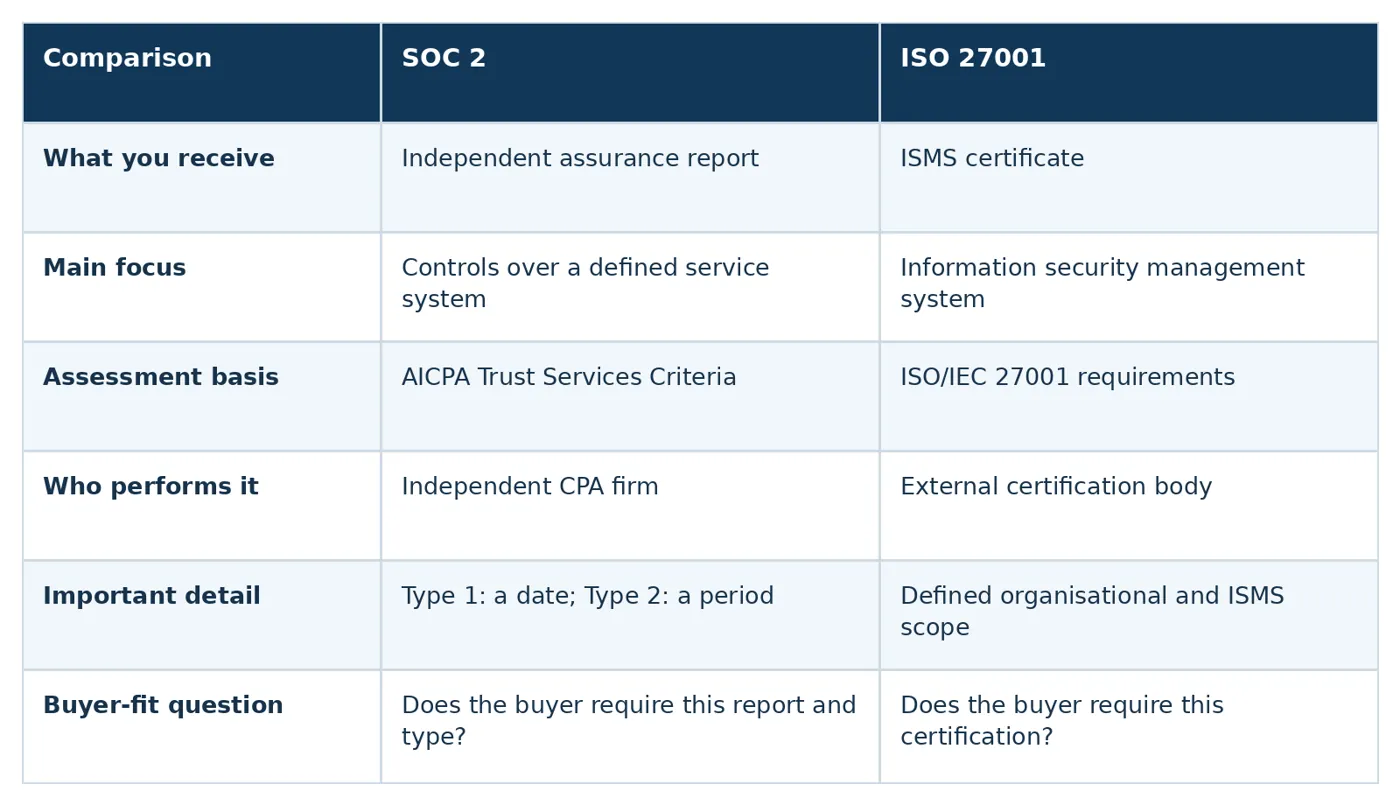
SOC 2 and ISO 27001 provide different forms of assurance. Sources: AICPA and ISO [1–4].
Both require meaningful work behind the documentation. The commercial value comes from relevant assurance supported by functioning controls—not simply displaying a mark on your website.
3. Which should your startup choose first?
Choose SOC 2 first when a required report is the immediate gate
If several credible prospects specifically require a SOC 2 Type 2 report covering your service, prioritising that requirement may be the most practical choice. Confirm the required categories, system scope, reporting period and acceptance conditions.
Do not assume another document will substitute. Ask the buyer’s security or procurement owner whether it will accept interim evidence and who can approve that exception. A business sponsor’s enthusiasm does not necessarily resolve the security requirement.
If SOC 2 is appearing repeatedly in buyer questionnaires, Explore Rex’s SOC 2 services
Choose ISO 27001 first when certification is the stated requirement
If target customers or tenders explicitly require ISO 27001 certification for the relevant service, start by defining an appropriate scope and assessing the gaps. Record any requirements concerning the certification body, accreditation or scope wording.
This may also be a useful starting point when leadership wants a structured programme for managing information security across the business. Balance that organisational objective with the evidence your near-term buyers will accept.
If buyers are asking for ISO 27001 certification, Explore Rex’s ISO 27001 compliance services
If either is accepted, compare the pipeline and the work
Avoid choosing only because a competitor displays a particular badge. Review your strongest opportunities, the frequency of each requirement and the practical effort needed to meet it.
Location alone is not a sufficient decision rule. A buyer’s procurement policy, industry, use case and data exposure matter more than assuming every customer in a country prefers the same document. Ask for the actual requirement.
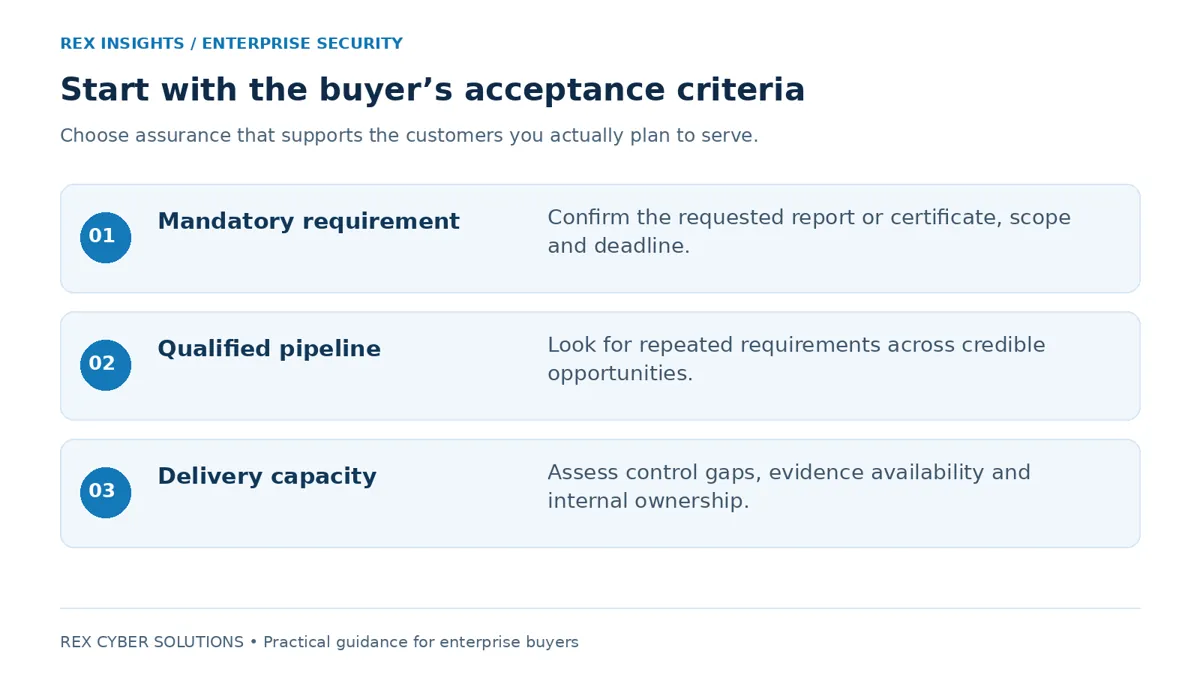
Document buyer requirements before choosing the order of your assurance programmes.
An example of a useful decision
Imagine a startup with two qualified prospects requiring SOC 2 Type 2 and another accepting either option. Starting with SOC 2 may address more immediate purchase conditions. If the situation is reversed and priority tenders mandate ISO 27001, certification may come first. These are illustrative scenarios, not a universal ranking.
If no credible buyer has specified either, begin with a security gap assessment and customer discovery. Fix material weaknesses while validating which assurance investment will serve the intended market.
4. How scope and timing change the decision
Scope should follow the service you sell
Identify the product, supporting infrastructure, teams, locations, suppliers and data involved. Discuss those boundaries with the relevant assessor. A narrow scope that leaves out the customer-facing service can undermine the purpose of the exercise.
Keep sales promises aligned with those boundaries. Avoid statements such as “all our products are covered” unless the issued documents actually support them.
Plan for the work before the assessment
Readiness may require changes to access management, incident response, supplier oversight, development practices or evidence collection. Policies alone will not demonstrate that a process operates. Assign owners and check the available records before selecting an assessment date.
For Type 2, the observation period is part of the evidence being examined. Buying a tool or finishing a gap assessment does not remove that requirement. Agree a realistic plan with the CPA firm and confirm whether it fits the buyer’s deadline.
For ISO 27001, ask the certification body to explain its assessment stages, follow-up requirements and ongoing certification arrangements. Include preparation, internal work and any corrective actions in the plan.
Compare total effort, not just the quotation
Request proposals against the same clearly defined scope. Include readiness support, independent assessment fees, remediation, tools, internal staff time and ongoing maintenance. A lower initial quote may exclude work your team still needs to perform.
Separate advisory support from the independent assessment. Understand who prepares the programme, who evaluates it and how independence is maintained. Avoid offers that imply an adviser can guarantee a favourable audit result.
5. When pursuing both makes sense
Both may be justified when distinct customer groups have firm requirements, or when expansion creates demand for a second form of assurance. The decision should be supported by business needs and delivery capacity, rather than a desire to collect badges.
Create a shared control inventory and map evidence to each programme’s requirements. Access reviews, change records, incident exercises and supplier reviews can be relevant to both. Confirm whether the scope, evidence period and detail are suitable for each assessment; reuse is not automatic equivalence.
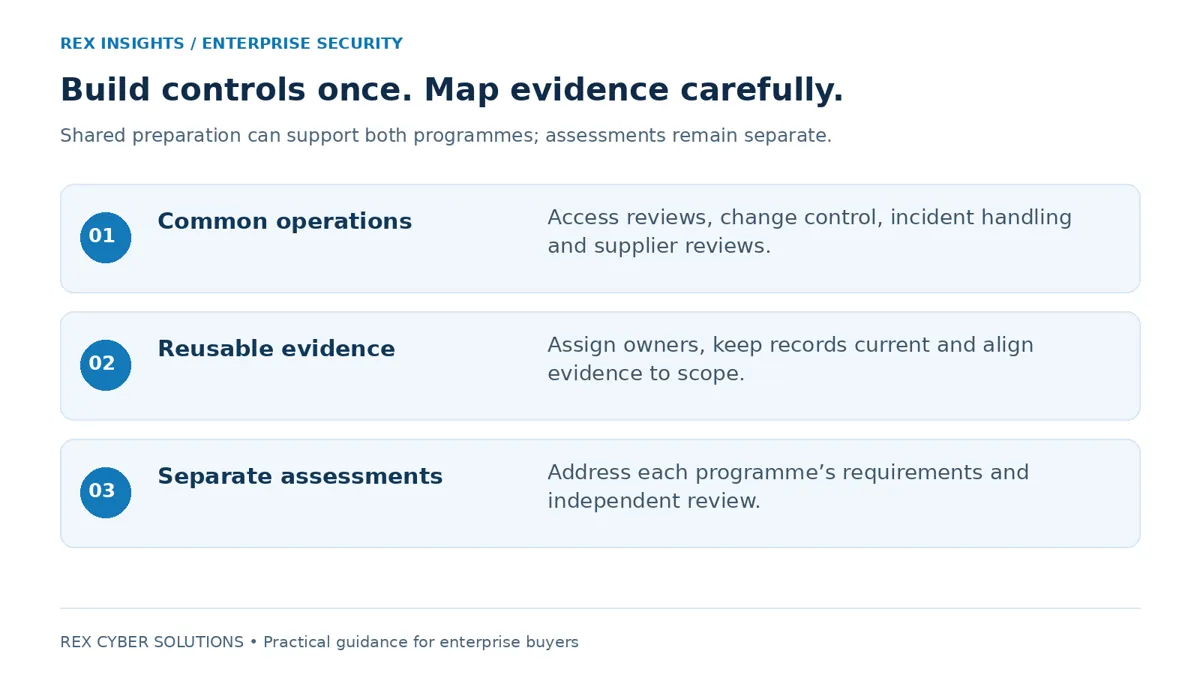
A shared operational foundation can reduce duplication while preserving separate assessment requirements.
If your team is small, sequence the programmes. Establish accountable owners and working controls, complete the first priority engagement, then address the remaining requirements for the second. Running both at once can make sense only if the team has the capacity to support them.
6. Questions to ask before approving a budget
1. Which qualified customers require this, and is it mandatory or preferred?
2. What exact report type, certificate scope or accreditation expectation applies?
3. Which service and supporting systems must be covered?
4. What evidence do we already have, and which controls need implementation?
5. Who will own the work inside engineering, operations and leadership?
6. Does the proposed schedule include preparation, assessment and follow-up?
7. What ongoing work and costs will remain after the first report or certificate?
8. Can existing controls support a later second programme without unnecessary duplication?
Record the answers in one decision note. This gives founders, sales and engineering a shared reason for the investment and a clear basis for explaining timing to customers.
7. Frequently asked questions
Q1. What is the main difference between SOC 2 and ISO 27001?
Answer: SOC 2 provides an independent report on controls over a service organisation’s system. ISO 27001 certification relates to an information security management system within a defined scope. Buyers may request either or both.
Q2. Which should a startup choose first?
Answer: Choose the option that addresses confirmed requirements across your priority customers, after checking scope, readiness and available resources. There is no universal first choice for every startup.
Q3. Is SOC 2 a certification?
Answer: The phrase “SOC 2 certification” is widely used in searches, but the formal deliverable is a SOC 2 assurance report. Describe your status accurately, including the report type and relevant scope.
Q4. Can ISO 27001 replace a SOC 2 report?
Answer: Only if the buyer accepts it for that engagement. Do not assume equivalence where the buyer has specified a particular document or type of evidence.
Q5. Does a startup need both immediately?
Answer: Not necessarily. Pursue both when customer requirements and business value justify the additional work. A phased approach can help a small team maintain reliable controls.
Q6. Will either remove the need for penetration testing?
Answer: No. Assurance documents and technical security testing serve different purposes. Agree appropriate testing based on your risks and customer requirements; neither document guarantees that an application has no vulnerabilities.
8. Choose your next step with Rex
The right starting point is the assurance your target customers will use, supported by a scope and plan your team can deliver.
Rex Cyber Solutions can help you assess readiness, identify gaps and plan the preparation for SOC 2 or ISO 27001. Bring your customer questionnaires, requested documents and target timeline to a discovery call so the discussion starts with your actual sales requirements.
Book a discovery call with Rex Cyber Solutions