
The Enterprise Bottleneck: Why Deferring Compliance Kills Sales Velocity
Your demo went well. The business team wants the product. Pricing is nearly agreed. Then procurement sends a vendor security assessment—and the deal stops moving.
The problem is rarely the questionnaire alone. It is what the questionnaire uncovers: unclear data flows, missing evidence, unresolved vulnerabilities or commitments that nobody has approved internally.
Enterprise clients ask for security compliance because your service can introduce risk into their organisation. When you handle sensitive data, connect to business systems or support a critical process, the buyer needs evidence that those risks are managed. Leaving that evidence until the end of a deal can turn a routine review into an engineering project.
For Indian SaaS companies and technology service providers selling to large organisations, enterprise readiness belongs in the sales plan as well as the security plan.
In this article
1. Why enterprise clients ask for security compliance
2. How compliance delays slow sales
3. What buyers actually need to see
4. Build an evidence pack before the questionnaire
5. Bring security into the deal earlier
6. Measure and manage the bottleneck
7. Frequently asked questions
8. Prepare for your next enterprise review
1. Why enterprise clients ask for security compliance
An enterprise is buying more than a feature set. It is accepting a relationship with another organisation—and potentially giving that organisation access to customer information, employee records, infrastructure or essential workflows.
A vendor security assessment helps the buyer decide whether that relationship is acceptable, which safeguards are needed and who must approve any remaining risk. Requirements may come from internal policy, customer contracts, sector rules or applicable law. They are not all legal mandates, and they are not identical across buyers.
The buyer’s questions have business consequences
1. Data protection: What information will you receive, where will it go and who can access it?
2. Operational resilience: If your service fails, can the buyer continue operating or recover promptly?
3. Incident response: Will the buyer know about an incident in time to take appropriate action?
4. Accountability: Can your team demonstrate that stated controls actually operate?
NIST’s supplier due-diligence guidance treats supplier and product information as an input to acquisition decisions. That is a useful way to understand the review: the buyer is deciding whether it can responsibly purchase and use your service. [1]
Some programmes make approval an explicit gate. Microsoft’s Supplier Security and Privacy Assurance programme states that new suppliers within its scope cannot start work until the required compliance cycle is complete. That is Microsoft’s own policy, but it illustrates why a willing business sponsor cannot always authorise deployment. [2]
Your champion may want the product. Security, privacy, legal and procurement may still need to approve the engagement.
2. How compliance delays slow sales
Deferring compliance creates work at the point when the team expects to close. Instead of exchanging final documents, the organisation must discover its current position, assign owners, repair gaps and wait for another review.
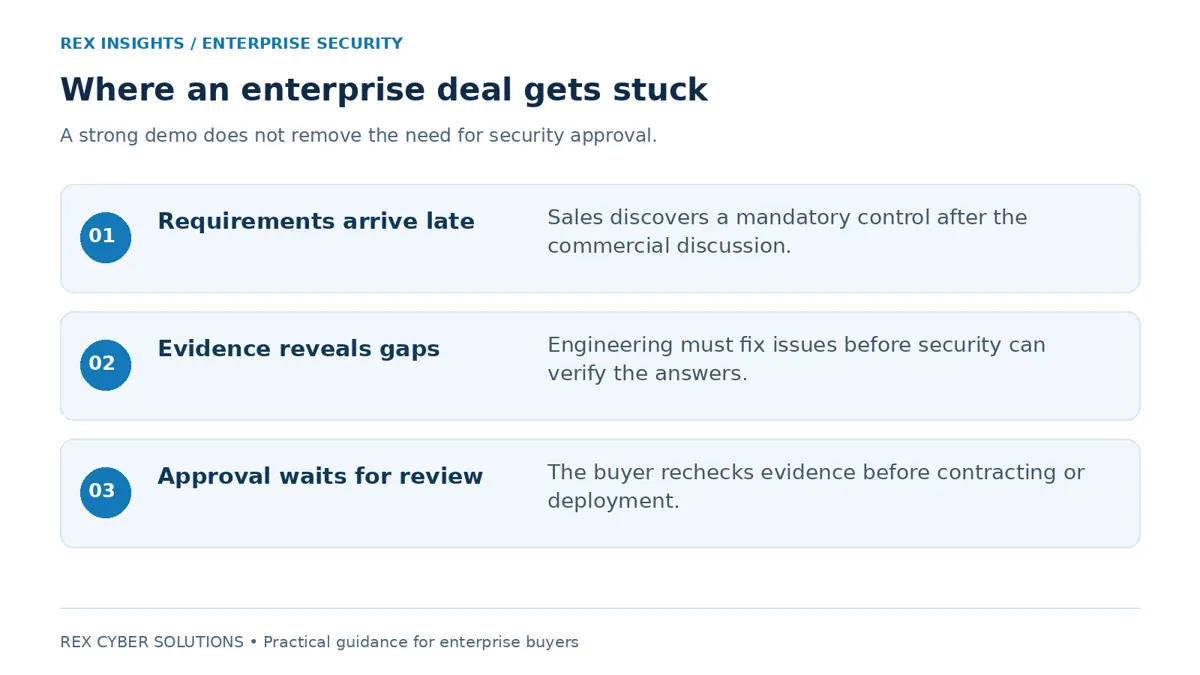
Late discovery can turn a security review into a sequence of remediation and approval steps.
The hidden cost is the dependency chain
Consider a hypothetical SaaS deal. The buyer asks for proof of administrative access controls, a recent penetration test and evidence that serious findings were resolved. The vendor has a policy document and an old test report, but no current remediation record.
Security cannot validate the response. Engineering must confirm what changed, address remaining findings and arrange verification. Sales then needs the buyer to reopen the assessment. Each handoff adds another dependency to the expected close date.
Even where the buyer accepts a remediation plan, that acceptance needs an authorised decision. A salesperson’s promise is not a substitute.
The commercial effects go beyond a delayed signature
1. Forecast uncertainty: A deal labelled “nearly closed” still has unresolved approval conditions.
2. Repeated work: Engineers and security staff answer variations of the same question without a maintained evidence library.
3. Reduced negotiating flexibility: Urgency may encourage concessions or delivery promises that the company has not properly assessed.
4. Delayed onboarding: A signed contract may still have security conditions before production use.
5. Lost momentum: The buyer may reconsider priorities or choose another option while the review remains unresolved.
Not every stalled deal is a compliance problem, and completing a framework does not guarantee a sale. The objective is to remove avoidable uncertainty from the parts of the buying process you can influence.
Have a questionnaire holding up an opportunity? Discuss your enterprise security requirements with Rex Cyber Solutions
3. What buyers actually need to see
Enterprise security requirements should be understood in the context of the service being purchased. A product that stores sensitive customer records may face a different review from a limited-access tool with no production data.
A relevant scope
The buyer needs to understand which product, environment, locations and activities your evidence covers. A document about a different business unit or an unrelated system may not answer the question.
Evidence behind the answer
“Yes, we review access” is stronger when supported by an approved process and a recent record showing that the review happened. The same principle applies to vulnerability remediation, recovery testing and incident handling. Share enough evidence to support the claim without exposing unnecessary sensitive detail.
Independent assurance where required
A buyer may request an ISO 27001 certificate, a SOC 2 report, penetration testing evidence or a combination. Ask what is mandatory for this engagement, what scope is expected and whether interim evidence can be considered. These documents serve different purposes and do not automatically replace the buyer’s own assessment.
The UK National Cyber Security Centre’s supplier assurance guidance emphasises questions about the actual service, including relevant certification scope, security testing and remediation. A badge alone does not establish that the purchased service meets the buyer’s needs. [3]
If target buyers require a formal information security management programme, Explore Rex’s ISO 27001 compliance services
If enterprise prospects are requesting a SOC 2 report, Explore Rex’s SOC 2 services
4. Build an evidence pack before the questionnaire
The most useful evidence pack is a maintained source of approved answers and supporting records. It should make it easier to respond accurately across deals, while showing where the organisation still has work to do.
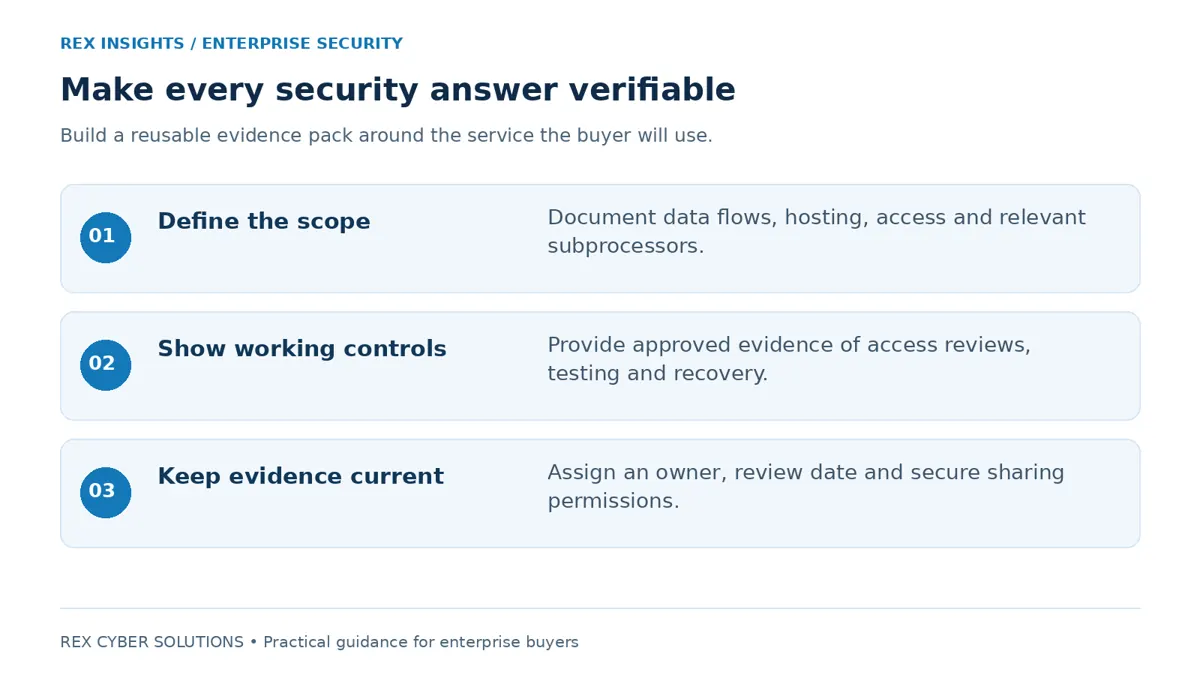
Organise evidence by scope, operating controls and ownership—not simply by document name.
1. Service overview: Describe the product, hosting model, data flows, integrations and relevant subprocessors.
2. Approved answer library: Record the exact claim, supporting evidence, responsible owner and last review date.
3. Access and security operations: Maintain evidence relevant to identity controls, privileged access, logging and incident handling.
4. Testing and remediation: Keep current assessment scope, findings status and verification evidence available for appropriate review.
5. Assurance documents: Retain applicable reports or certificates with their scope, dates and any relevant limitations.
6. Resilience and privacy: Prepare relevant recovery evidence, retention and deletion information, and proposed data-processing commitments.
7. Open-gap register: Assign each unresolved requirement a risk owner, action, target date and status.
Separate public information from restricted evidence. A general security overview can be widely shared; detailed test reports, architecture documents and sensitive operational records may need controlled access and appropriate confidentiality terms. Do not publish raw vulnerability detail simply to make procurement easier.
Refresh the pack when important changes occur—not only when a salesperson asks for it. New hosting arrangements, integrations or product capabilities can make a previously accurate answer misleading.
If a buyer needs application testing evidence, Review Rex’s web penetration testing services
5. Bring security into the deal earlier
Security discovery should begin when the opportunity becomes a credible enterprise engagement. The aim is to learn the approval conditions early enough to plan against them.
Ask these questions before committing to a close date
1. What security and privacy requirements apply to this specific use case?
2. Which reports, controls or contractual commitments are mandatory?
3. Who owns the review, and who can approve exceptions?
4. What evidence is needed before contract signature, onboarding and production use?
5. When can the review start, and what dependencies could extend it?
Then distinguish between three situations: the control exists and needs evidence; the evidence is unclear or outdated; or the control itself needs implementation. These require different work and different timelines.
Do not answer “yes” because a feature is on the roadmap. Explain the current state, the proposed change and the realistic delivery date. If the buyer is willing to consider an exception or compensating control, obtain the appropriate documented approval.
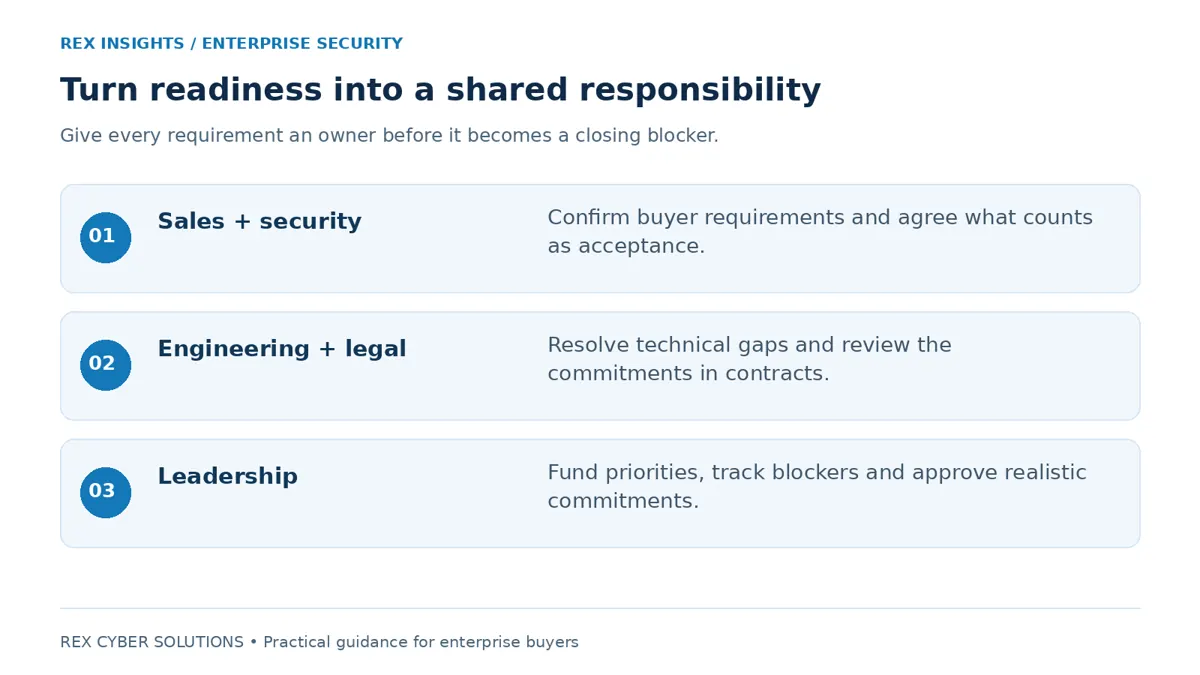
Sales, security, engineering and legal need one shared view of the buyer’s requirements.
Give each opportunity one coordinator and each requirement one accountable owner. Sales manages communication and expectations. Security validates claims. Engineering implements technical changes. Legal reviews contractual commitments. Leadership resolves resource conflicts and approves commitments within its authority.
6. Measure and manage the bottleneck
A long questionnaire is not automatically a slow review. A short questionnaire with one unresolved mandatory requirement can hold a deal for longer. Track the work that actually prevents approval.
1. Review age: How long has each assessment been open, and how much time is waiting on your team versus the buyer?
2. Response turnaround: How quickly can your team provide a complete, validated first response?
3. Rework: How often are answers returned because the evidence is missing, inconsistent or out of scope?
4. Blocking gaps: Which requirements prevent the buyer from progressing, and who owns each one?
5. Discovery timing: At what sales stage are mandatory security requirements first identified?
Review these measures alongside deal notes. A procurement delay, budget freeze or contract dispute should not be recorded as a security delay merely because a questionnaire is also open.
Use recurring buyer requirements to prioritise investment. A control repeatedly requested by well-qualified target customers may deserve earlier attention than a one-off request from a poor-fit prospect. Security risk must remain part of that decision; pipeline value alone does not determine what should be fixed.
7. Frequently asked questions
Q1. Why do enterprise clients ask for security compliance?
Answer: They need to assess the risks of relying on your service, sharing data or granting access. The review helps them decide whether your controls and commitments meet their procurement, contractual and applicable regulatory obligations.
Q2. How can compliance delays affect sales?
Answer: Missing evidence or unresolved controls can delay security approval, contracting or deployment. They can also create repeated internal work and weaken forecast confidence. The effect depends on the buyer’s requirements and whether approved alternatives are available.
Q3. Do all enterprise customers require ISO 27001 or SOC 2?
Answer: No. Requirements depend on the buyer, service, data and risk involved. Confirm the exact requirement, relevant scope and acceptable evidence before choosing an assurance programme.
Q4. Can we close a deal while remediation is still in progress?
Answer: Sometimes, if the buyer’s authorised team accepts the remaining risk and the agreed conditions. Other requirements are mandatory before signature or go-live. Confirm the approval route rather than assuming a remediation plan will be accepted.
Q5. Will a completed security questionnaire replace penetration testing?
Answer: No. A questionnaire records claims and evidence; penetration testing evaluates security weaknesses within an agreed technical scope. A buyer may require both, including evidence that significant findings were addressed.
Q6. Where should a growing Indian company start?
Answer: Start with the requirements of credible target buyers, the systems and data in scope, and an honest gap assessment. Assign owners, address material weaknesses and build a reusable evidence pack before pursuing additional assurance documents.
8. Prepare for your next enterprise review
Enterprise compliance becomes a sales bottleneck when the organisation starts preparing only after a buyer asks for proof. Earlier discovery, working controls and clear evidence help your team give credible answers—and make realistic commitments.
If a security questionnaire is blocking a live opportunity, start with the actual requirements. Rex Cyber Solutions can help you understand the gaps, prioritise the work and prepare the evidence needed for the review.
Bring your buyer’s questionnaire, required assurance documents and expected deal timeline. Use the discovery call to discuss what already exists, what needs attention and which service fits your next step.
Book a discovery call with the Rex Cyber Solutions team