VAPT Cost in India: What You’re Paying For vs What Actually Gets Tested
The uncomfortable truth about VAPT pricing in India
Most businesses in India start with a simple question:
“How much does a VAPT cost?”
But almost no one asks:
👉 “What exactly is being tested for that cost?”
Because VAPT pricing in India is not just about:
It’s about something far more critical:
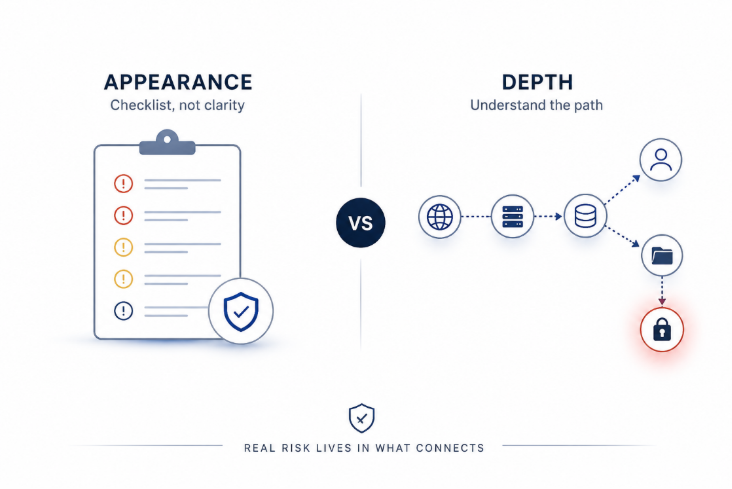
👉 Depth vs appearance
Two vendors can test the same application.
Both deliver a report. Both list vulnerabilities. Both mark issues as critical, high, medium.
But only one might answer:
👉 Can an attacker move through your system using what already exists?
And that difference is where real risk lives.
Why VAPT pricing in India varies so widely
In the Indian market, VAPT pricing usually falls into broad categories:
Type of Testing
Typical Price Range (India)
Basic Web Application VAPT
₹20,000 – ₹75,000
Web + API Testing
₹75,000 – ₹2,00,000
Mobile + Backend Testing
₹1,50,000 – ₹4,00,000
Cloud / Infrastructure VAPT
₹2,00,000 – ₹6,00,000
Advanced / Red Team / Simulation
₹5,00,000 – ₹20,00,000+
At first glance, this looks like a difference in scope.
It reflects something deeper:
👉 What is being tested and what is being ignored
What most VAPT services in India test
1. Vulnerability Identification (Surface-Level Testing)
Most VAPT engagements focus heavily on:
These are important. No doubt.
But they are also:
👉 Predictable and tool-detectable
In many cases:
The output becomes:
✔️ A list of vulnerabilities
✔️ Severity ratings (CVSS)
✔️ Remediation steps
But what’s missing?
👉 Context of how these issues connect
2. Component-Level Testing
Most testing happens in isolation:
Each component may pass.
But no one asks:
👉 This is where real exploitation happens
3. Compliance-Driven Testing
A large portion of VAPT in India is driven by:
So, the objective shifts to:
✔️ Completing the assessment
✔️ Closing findings
✔️ Submitting reports
Instead of:
❌ Validating real-world exploitability
Testing becomes:
👉 But not adversarial
What you’re NOT paying for (but assume you are)
Most organizations believe VAPT includes deep attack simulation. Most engagements don’t test these areas at all:
1. Attack Path Chaining
Real attackers don’t exploit one issue.
They:
Example:
A medium-risk issue becomes critical when combined with:
👉 Most VAPT reports never show this chain
2. Identity and Access Abuse
Modern systems rely on:
But testing rarely includes:
👉 Nothing is “broken”
But everything is misused
3. Integration and Third-Party Risk
Today’s applications depend on:
Each integration creates:
👉 A trusted bridge into your environment
But most VAPT scopes:
👉 Yet many real breaches start here
4. Real-World Behaviour Testing
Most VAPT does not answer:
Because testing focuses on:
✔️ Vulnerabilities
Instead of
👉 System behaviour
The real cost difference: Checklist vs Reality
Aspect
Low-Cost VAPT
High-Value VAPT
Focus
Vulnerabilities
Attack paths
Method
Tool-driven
Scenario-driven
Output
Issue list
Exploitation flow
Testing Style
Component-based
End-to-end
Identity Testing
Minimal
Deep validation
Integration Risk
Ignored
Actively tested
Result
Compliance-ready
Breach-aware
The difference is not:
👉 “More findings”
It is:
👉 Whether your system was tested the way an attacker would use it
Why this gap is growing in India
1. API-Driven Architectures
Modern applications are:
Risk no longer sits in a single component.
It exists in:
👉 How requests flow across systems
2. Cloud and Identity Explosion
With cloud adoption:
Security shifts from:
❌ Who has access
To:
✔️ How access behaves across systems
3. Third-Party Dependency Growth
Across SaaS, fintech, and enterprise platforms:
👉 Every integration increases reachability
4. Compliance vs Reality Gap
India’s regulatory landscape is tightening:
But compliance frameworks:
👉 Validate controls, not behaviour
So organizations:
How to evaluate VAPT pricing the right way
Instead of asking:
“What is the cost?”
Ask:
1. What scenarios are being tested?
2. Is testing component-based or end-to-end?
3. Are real attacker techniques used?
4. What does the report show?
5. Does the testing reflect YOUR architecture?
Or just a generic checklist?
A real-world perspective most reports miss
Consider a SaaS company:
VAPT result:
✔️ “Low risk”
Reality:
An attacker:
They:
👉 Use valid access in unintended ways
Result:
And none of it appears in the report.
Final Thought: You’re not paying for a report. You’re paying for reality.
Most VAPT engagements answer:
✔️ What is vulnerable
But very few answer:
👉 What is exploitable
You can:
And still miss the same thing:
👉 How your system behaves under real attack conditions
Because:
Attackers don’t break systems.
They use them exactly as designed just in ways you didn’t expect.
What effective VAPT should deliver
A meaningful VAPT is not defined by the number of findings.
It is defined by what it proves.
It should answer:
✔️ How an attacker can move through your environment
✔️ How access expands beyond intended boundaries
✔️ How APIs, cloud, and integrations behave under pressure
✔️ Whether controls hold when assumptions change
Because in modern environments:
👉 Risk is not defined by what is broken
👉 It is defined by what is reachable
The real question to ask before your next VAPT
Before selecting a vendor or evaluating a quote, don’t ask:
❌ “How much does it cost?”
Ask:
👉 “Will this test show how an attacker would actually use my system?”
If the answer is unclear:
Then the test is likely focused on reporting issues, not validating risk.
Closing Perspective
Security today is not failing because controls are missing.
It is failing because:
And most testing still focuses on:
✔️ What exists
Instead of
👉 How everything connects
Nothing may look broken.
Everything may pass audits.
But:
Nothing looks open until everything connects.
Frequently Asked Questions [FAQs]
1. What is the average VAPT cost in India?
Typically, ₹20,000 to ₹6,00,000+, depending on scope and depth.
2. Why are some VAPT services so cheap?
Because they rely heavily on automated tools and focus only on known vulnerabilities.
3. Does VAPT include API and cloud testing?
It should but many engagements limit or exclude deep API flow and identity testing.
4. How do I know if my VAPT is effective?
If it shows attack paths, access misuse, and real exploitability—not just vulnerability lists.
5. Is VAPT enough for ISO 27001 or DPDPA?
It helps with compliance but does not guarantee real-world security validation.

%20(1).png)
.png)

.png)