What Is VAPT? Why Traditional Testing Fails to Expose Real Attack Paths in 2026
Introduction: The Illusion of “Tested Security”
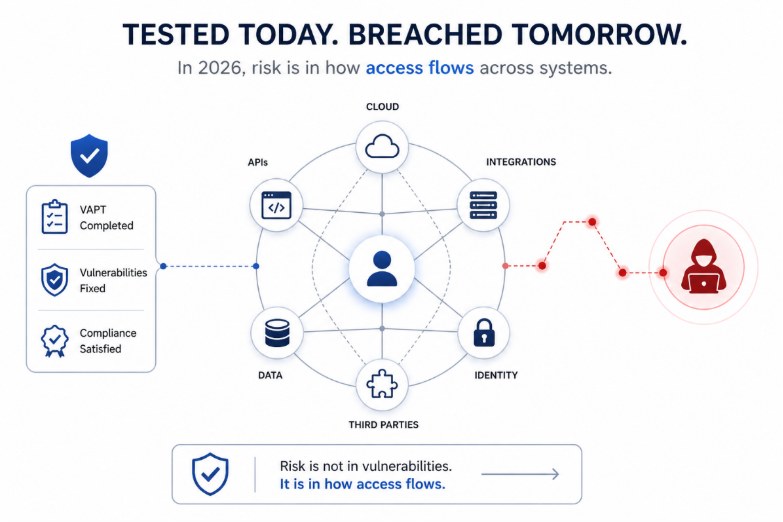
Most organizations today believe they are secure because they have completed a VAPT exercise.
And yet, breaches continue.
Not because security controls are missing.
But because what was tested does not reflect how systems are used and abused in real environments.
In 2026, this gap is widening rapidly.
Modern architectures are:
Which means:
👉 Risk is no longer defined by vulnerabilities. It is defined by how access flows across systems.
This is where traditional VAPT starts to fail.
What Is VAPT? (Beyond the Definition)
VAPT (Vulnerability Assessment and Penetration Testing) is typically understood as:
But this definition is incomplete.
What VAPT should represent
Traditional View
Modern Reality
Find vulnerabilities
Understand attack paths
Score risk (CVSS)
Validate real exploitability
Test components
Test system behaviour
Static snapshot
Dynamic, evolving exposure
👉 VAPT is not about “what is vulnerable.”
👉 It is about what is reachable, chainable, and exploitable in context.
Why Traditional VAPT Fails in 2026
1. It Tests Components, Not Connections
Most VAPT exercises focus on:
Each is tested in isolation. But attackers don’t attack in isolation. They move across systems.
Example attack path:
No single vulnerability. But a complete breach.
👉 Traditional VAPT misses this because it does not test how components interact.
2. It Ignores Access Propagation
Modern systems rely heavily on:
But access does not stay contained.
It propagates.
Critical question most VAPT does NOT ask:
👉 “If access starts here, where else can it go?”
Instead, testing focuses on:
While ignoring:
3. CVSS Does Not Reflect Real Risk
Severity scores create a false sense of prioritization.
Scenario
CVSS Score
Real Risk
Low-severity API
misconfigure
3.5
Enables lateral movement
Medium auth flaw
6.5
Leads to privilege escalation
High severity XSS
8.0
Limited real impact
👉 Attackers don’t exploit “high scores.”
👉 They exploit what can be chained together.
4. It Fails to Simulate Real Attack Paths
Traditional penetration testing often validates:
But not:
👉 Real attacks are not single-step events.
👉 They are multi-step journeys across trust boundaries.
5. It Ignores Integration Risk
Every integration introduces:
Common integrations:
But VAPT rarely tests:
👉 Many real-world breaches happen through trusted integrations not direct attacks.
The Core Shift: From Vulnerabilities to Attack Paths
This is the most important shift in 2026.
Traditional Security Thinking
Modern Security Thinking
Vulnerability vs Attack Path: The Real Difference
Aspect
Vulnerability-Based Testing
Attack Path-Based Testing
Focus
Individual flaws
System-wide behaviour
Scope
Single component
Cross-system interactions
Output
Vulnerability list
Exploitable paths
Risk View
Static
Dynamic
Value
Compliance-driven
Security assurance
👉 Vulnerabilities show what is broken.
👉 Attack paths show what is usable by attackers.
What Effective VAPT Must Validate in 2026
To remain relevant, VAPT must evolve.
1. Access Chain Mapping
Understanding how access flows across systems:
👉 Goal: Identify unintended access propagation
2. Identity and Token Abuse
Modern systems depend on identity.
Test for:
3. Integration Path Exploitation
Every integration is a bridge.
Test:
4. Lateral Movement Across Systems
Simulate:
5. Data Reachability Validation
Not just:
But:
👉 “Can data be reached through indirect paths?”
Why This Gap Is Growing Faster in 2026
Modern environments are accelerating complexity:
Every new system adds functionality.
👉 It also adds new attack paths.
And most of these paths are:
Real-World Pattern: How Attacks Actually Happen
Across industries SaaS, BFSI, healthcare the pattern is the same:
👉 Nothing is “broken.”
👉 Everything works as designed.
But:
👉 The design allows unintended access paths.
Why Compliance-Driven VAPT Falls Short
Compliance frameworks (ISO 27001, DPDPA, etc.) focus on:
They validate:
But they do NOT validate:
What Organizations Should Demand from VAPT
To close this gap, organizations must shift expectations.
Old Expectation
New Expectation
Key Questions to Ask Your VAPT Provider
If the answer is no:
👉 You are not testing security.
👉 You are documenting it.
Final Thought: Security Is Not What Exists. It’s What Connects.
You can:
And still be exposed.
Because:
👉 Attackers don’t break systems.
👉 They use them exactly as designed just in ways you didn’t expect.
Nothing looks open.
Until everything connects.
And when it does:
👉 The attack path already exists.
Frequently Asked Questions [FAQs]:
1. Is VAPT still relevant in modern environments?
Yes, but only if it evolves.
Traditional VAPT is not enough.
Modern VAPT must focus on attack paths, not just vulnerabilities.
2. How often should VAPT be performed?
Not just annually.
It should be:
Because:
👉 Attack paths change faster than vulnerabilities.
3. Does fixing vulnerabilities eliminate risk?
No.
Fixing vulnerabilities reduces risk.
But it does NOT eliminate:
4. What is the biggest mistake organizations make?
Assuming:
👉 “No critical vulnerabilities = secure system”
In reality:
👉 Systems are breached through low-severity issues chained together.
5. How is modern VAPT different from traditional penetration testing?
Modern VAPT:
Traditional testing:

%20(1).png)
.png)

.png)