
What Security Controls Should an AI SaaS Startup Have Before Selling to Enterprises?
Your AI product can summarise a contract, search internal knowledge or automate a support workflow. The enterprise buyer’s next question is harder: what stops it from exposing confidential information or taking an action it should never have been allowed to take?
Before an AI SaaS startup handles enterprise data, it needs a secure SaaS foundation, clear boundaries around model access and actions, and evidence that those protections work. A strong model provider or a carefully written system prompt does not cover the security of your application.
This guide focuses on generative AI SaaS products, including retrieval-augmented generation and tool-using agents. The controls below are a practical starting point for founders and engineering leaders. The final scope should reflect the product’s data, integrations, permitted actions and the buyer’s requirements.
In this article
1. What enterprise customers expect from AI SaaS
2. Ten controls to prioritise before enterprise deployment
3. What to demonstrate in a security review
4. How to sequence the work
5. Frequently asked questions
6. Prepare your AI SaaS product for enterprise review
1. What enterprise customers expect from AI SaaS
Enterprise buyers need to understand what your product can access, where their information goes and who remains accountable when something fails. A security review may include the application, cloud environment, model providers, connected systems and your operating processes.
Expect questions about customer data being used for model training, isolation between customers, administrative access, incident handling and evidence of independent testing. Requirements vary: a read-only assistant using public information has a different risk profile from an agent that reads employee records and updates production systems.
NIST’s Generative AI Profile provides a voluntary resource for considering trustworthiness throughout the AI lifecycle. It is useful for organising risk discussions; it is not a universal approval certificate for enterprise sales. [1]
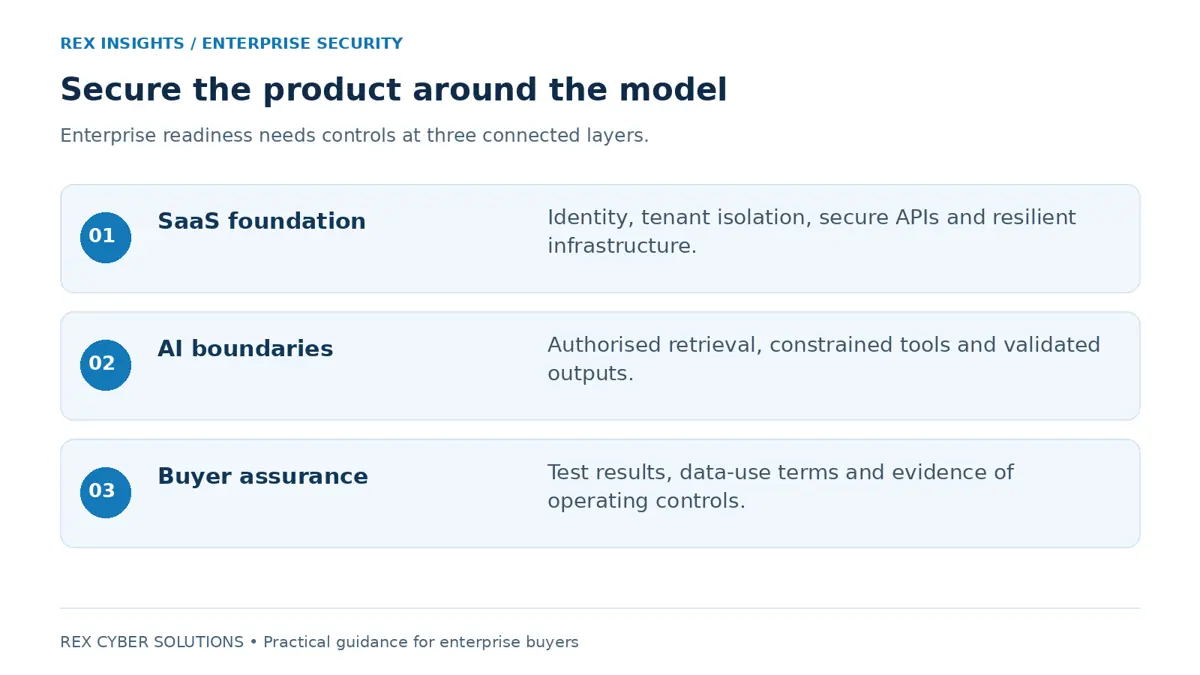
AI application security includes the surrounding product, integrations and operating processes.
2. Ten controls to prioritise before enterprise deployment
Control 1. Map data flows and define permitted data use
Document what enters the product, how it is processed and every place it can persist. Include prompts, uploaded files, retrieved passages, embeddings, generated responses, feedback, analytics and support logs. Treat embeddings as potentially sensitive derived data, not automatically anonymous records.
Identify each model or infrastructure provider, relevant processing locations and the settings and contractual terms governing retention and training use. Do not promise “your data is never used for training” unless that statement is supported across your own processes and every relevant provider and feature.
Define permitted uses of customer data and obtain the appropriate authorisation for training or fine-tuning. Establish deletion and retention procedures for primary records, indexes, caches and backups, including any limits that must be explained to customers.
Control 2. Protect identities and privileged access
Require multi-factor authentication for privileged accounts. Use individual identities, role-based permissions, controlled service accounts and prompt access removal when people leave or change roles. Restrict production support access and retain records of privileged activity.
Ask target buyers early about single sign-on, automated provisioning and customer-managed roles. These may become purchasing requirements. Implement authorisation in the application and APIs; hiding a button in the interface is not an access control.
Control 3. Enforce tenant and document isolation
For retrieval-augmented generation, or RAG, apply access checks before documents are selected and sent to the model. A user must not receive another customer’s information—or a restricted document from their own organisation—because it happens to be relevant to a search.
Carry tenant and user permissions through databases, object storage, vector indexes, background jobs, conversation history, caches and exports. Recheck access when permissions change. Test both cross-tenant access and access between users with different roles inside one tenant.
A prompt that tells the model to ignore unauthorised information is too late if that information has already entered its context.
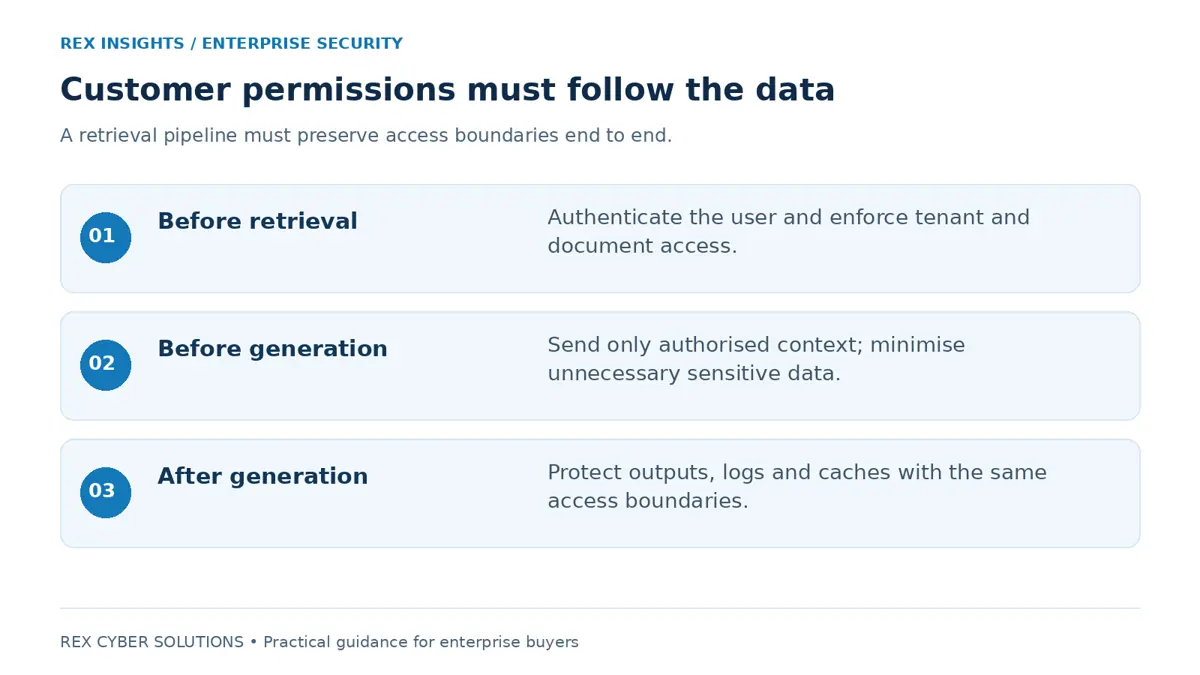
Keep access enforcement outside the model and preserve it throughout the retrieval pipeline.
Control 4. Reduce the impact of prompt injection
Treat user input and external content—including uploaded documents, retrieved pages and tool responses—as untrusted. A document can contain instructions that try to redirect the assistant, disclose information or influence a connected action.
OWASP identifies direct and indirect prompt injection as application risks and explains that RAG and fine-tuning do not fully eliminate them. [2] Use clear separation between trusted instructions and external content, input and output checks, and adversarial tests. More importantly, design the application so a manipulated response cannot bypass authorisation or obtain unnecessary privileges.
Keep secrets out of system prompts. Use filtering and guardrails as additional safeguards, while assuming some malicious content may still reach the model.
Control 5. Constrain tools and require meaningful approval
Give an agent only the tools and permissions it needs. Prefer read-only access where possible, narrowly scoped credentials, destination allowlists and explicit limits on what operations are permitted. Avoid giving a general-purpose agent unrestricted access to a shell, database or administrator account.
For each proposed action, validate the authenticated user, target resource, operation and arguments in ordinary application code. For high-impact activities—such as sending external messages, deleting records or changing permissions—require an authorised person to review the actual action and destination before execution.
Bind approval to that specific action so it cannot silently change afterward. Record execution results and provide a practical way to stop the agent and recover where possible. OWASP’s excessive-agency guidance identifies excessive functionality, permissions and autonomy as key sources of this risk. [3]
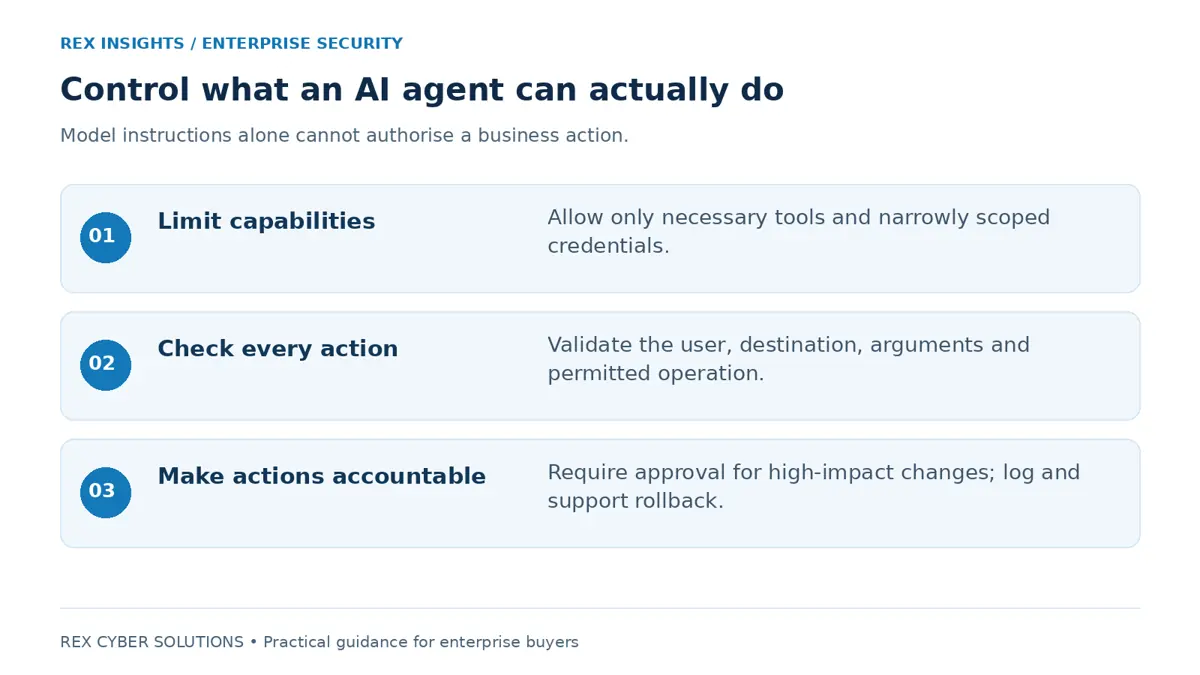
Permissions, validation and approval should remain enforceable even if the model produces an unsafe instruction.
Control 6. Handle model output as untrusted input
Validate generated outputs before another system consumes them. Use appropriate schema validation, parameterised database operations and output encoding. Do not execute generated code, SQL or commands directly in a privileged environment.
If code execution is part of the product, use an isolated environment with restricted network access, limited credentials and resource limits. Validate file paths and outbound requests. A plausible-looking response should not become an unrestricted instruction to the operating system.
Control 7. Secure the application and cloud foundation
AI features do not remove conventional SaaS security obligations. Protect data in transit and at rest, manage encryption keys appropriately, keep secrets in a dedicated secrets-management system and separate production from development environments.
Use code review, dependency and secret scanning, secure configuration checks and a vulnerability-management process with accountable owners. Review third-party packages, model artefacts and integration components before use. Track versions and restrict who can change deployed models, prompts and retrieval settings.
Include authentication, authorisation, APIs, file upload, integrations and tenant isolation in penetration-testing scope. AI-specific testing should extend that scope rather than replace it.
Need to assess the application behind your AI features? Explore Rex’s web application penetration testing
For cloud permissions, exposed services and configuration risks, Explore Rex’s cloud penetration testing services
Control 8. Monitor abuse without creating a new data leak
Log security-relevant events: sign-ins, administrative changes, access denials, retrieval decisions, tool requests, approvals and execution outcomes. Make it possible to connect an event to the relevant tenant, user and deployed configuration.
Avoid collecting full prompts and customer documents by default simply because they are useful for debugging. Minimise or redact sensitive content, restrict log access and set retention periods. Confirm that telemetry providers are included in your data-flow review.
Add rate limits, usage quotas, timeouts and spend controls to reduce abuse and runaway agent activity. Alert on unusual access patterns, repeated denied actions and unexpected cost spikes, with a named person responsible for responding.
Control 9. Prepare for incidents and service disruption
Write and rehearse an incident process that includes AI-specific scenarios: cross-tenant disclosure, a compromised integration credential, unsafe agent actions or sensitive information sent to an unintended provider.
Know how to disable an integration, revoke credentials, preserve appropriate evidence and communicate with affected customers. Establish responsibilities and notification commitments with legal input and the buyer’s agreed terms. Do not assume one deadline applies to every incident or customer.
Test recovery and define safe behaviour when a model provider is unavailable. Any fallback model or provider should be reviewed for its own data handling and security implications before it is activated.
Control 10. Evaluate changes before release
Maintain a repeatable evaluation set that covers the product’s real risks: unauthorised retrieval, sensitive-data disclosure, prompt injection, unsafe tool use and incorrect or unsupported outputs in important workflows.
Record the versions of models, prompts, tools and retrieval configurations tested. Set release criteria, investigate failures and retest after material changes. Keep a rollback option. For high-impact use cases, define when human review is necessary and make product limitations clear.
A test result describes the tested scope and configuration. It does not prove that every future prompt or model update will behave safely.
3. What to demonstrate in a security review
Enterprise buyers need clear answers supported by evidence. Prepare a compact, controlled evidence pack rather than asking engineering to reconstruct the product’s security story for every deal.
1. Architecture and data flows: Show relevant providers, storage locations, integrations and trust boundaries.
2. Data-use commitments: Explain training use, retention, deletion, subprocessors and any configuration-dependent limitations.
3. Access evidence: Demonstrate privileged access controls, tenant isolation and document-level permissions.
4. Testing and remediation: Provide a suitable assessment summary, scope, findings status and verification of important fixes.
5. AI evaluations: Summarise the scenarios tested, known limitations, release criteria and owners of unresolved risks.
6. Operational readiness: Provide relevant incident, recovery and change-management evidence.
7. Assurance scope: Share applicable reports or certificates through appropriate access-controlled channels.
Some buyers will ask for a SOC 2 report or ISO 27001 certification. Confirm the required scope and timing before committing. These forms of assurance can support a review, but neither substitutes for testing your particular AI workflows.
If a buyer has requested SOC 2 evidence, Explore Rex’s SOC 2 readiness services
4. How to sequence the work
Before a pilot with customer data
Agree on the intended use and data boundaries. Establish access controls, tenant separation, provider terms, safe handling of sensitive information and an incident contact. Use synthetic or appropriately de-identified data where feasible. A pilot using confidential data still needs safeguards.
Before production deployment
Test the complete application and relevant AI misuse scenarios. Resolve unacceptable risks, validate logging and recovery, and confirm what the buyer requires for production approval. Keep agent actions within approved limits and verify that data-use promises match actual settings.
As the product and customer base grow
Automate repeatable evidence collection, improve provisioning and access reviews, and align assurance work with customer needs. Reassess controls when adding models, connectors, sensitive data types or greater agent autonomy. A feature that changes what the product can do can also change its security obligations.
Assign one accountable owner to every material gap. A roadmap item is not an implemented control; describe its current status honestly in customer questionnaires.
5. Frequently asked questions
Q1. What security controls should AI startups have?
Answer: Start with identity protection, tenant isolation, clear data-use rules, secure application and cloud controls, vulnerability management, logging and incident response. Add authorised retrieval, prompt-injection resilience, constrained tool access and repeatable evaluations for AI features.
Q2. What do enterprise customers expect from AI SaaS companies?
Answer: They expect clear information about data use, providers, access, isolation, testing, incidents and service reliability. Buyers may also require contractual commitments or independent assurance. Confirm requirements for the specific use case rather than assuming every enterprise asks for the same package.
Q3. Is using a well-known model provider enough?
Answer: No. Your startup remains responsible for its application design, customer permissions, integrations, secrets, configuration and representations to buyers. Review the provider’s terms and safeguards, then secure the parts your team controls.
Q4. Can a system prompt prevent sensitive data leaks?
Answer: It can guide model behaviour, but it is not a dependable confidentiality boundary. Prevent unauthorised data from reaching the model, enforce permissions in application code and constrain what integrations can access or do.
Q5. Does an AI SaaS startup need SOC 2 before its first enterprise sale?
Answer: Not universally. Some buyers require it; others assess different evidence or approve a limited engagement. Ask early about mandatory reports, their scope and any permitted alternatives. Never describe planned assurance as already completed.
Q6. What should an AI application security assessment include?
Answer: It should cover conventional web, API and cloud risks alongside the relevant AI data flows, retrieval permissions, prompt injection, tool authorisation, output handling and abuse scenarios. Agree the scope with the assessor and include remediation verification.
6. Prepare your AI SaaS product for enterprise review
Enterprise readiness starts with being able to explain—and demonstrate—how customer data and business actions stay under control. The strongest starting point is an assessment of your actual product, including its architecture, permissions and integrations.
Bring your architecture overview, model-provider list and any customer security questionnaire to a discovery call with Rex Cyber Solutions. Discuss your application and cloud testing needs, identify the gaps to prioritise, and confirm the scope required for your AI-specific workflows.
Book a discovery call with Rex Cyber Solutions