
When Enterprise Buyers Start Asking Questions: Why ISO 27001 Matters for SaaS
By Rex Cyber Solutions
The product demo went well. Your champion likes the platform. Then procurement sends a security questionnaire: who can access customer data, how do you recover from an outage, and are you ISO 27001 certified? The answers now need input from engineering, operations and leadership before the deal can move forward.
For a SaaS company selling to enterprises, this is a useful signal. Your product is being evaluated as part of someone else’s business risk. A convincing response needs clear ownership and evidence that your security practices work.
ISO 27001 can help organise that work. This article explains what it means, how to prepare for buyer questions and where certification fits into an enterprise sales conversation.
In this article
1. Why enterprise buyers ask for security evidence
2. What ISO 27001 means for a SaaS company
3. Five questions to prepare for before the next deal
4. Build a security evidence pack your team can maintain
5. Seven questions for SaaS leadership
6. Frequently asked questions
7. Prepare for your next enterprise security review
1. Why enterprise buyers ask for security evidence
Imagine an HR platform that stores employee records and connects to a buyer’s identity system. A weakness in support access, tenant separation or recovery could affect the buyer’s own operations. It is reasonable for that buyer to ask how those risks are managed before granting access or uploading data.
Treat the questionnaire as a request for an accountable explanation. “We use a leading cloud provider” does not describe your application permissions. “We take backups” leaves open whether a restore has been tested. “We have a policy” does not show when the process last ran.
A useful answer describes the current control, names its owner and points to suitable evidence. Where a gap exists, state it clearly and explain the remediation plan. The buyer decides whether that position meets its requirements; a certificate cannot guarantee approval or a shorter sales cycle.
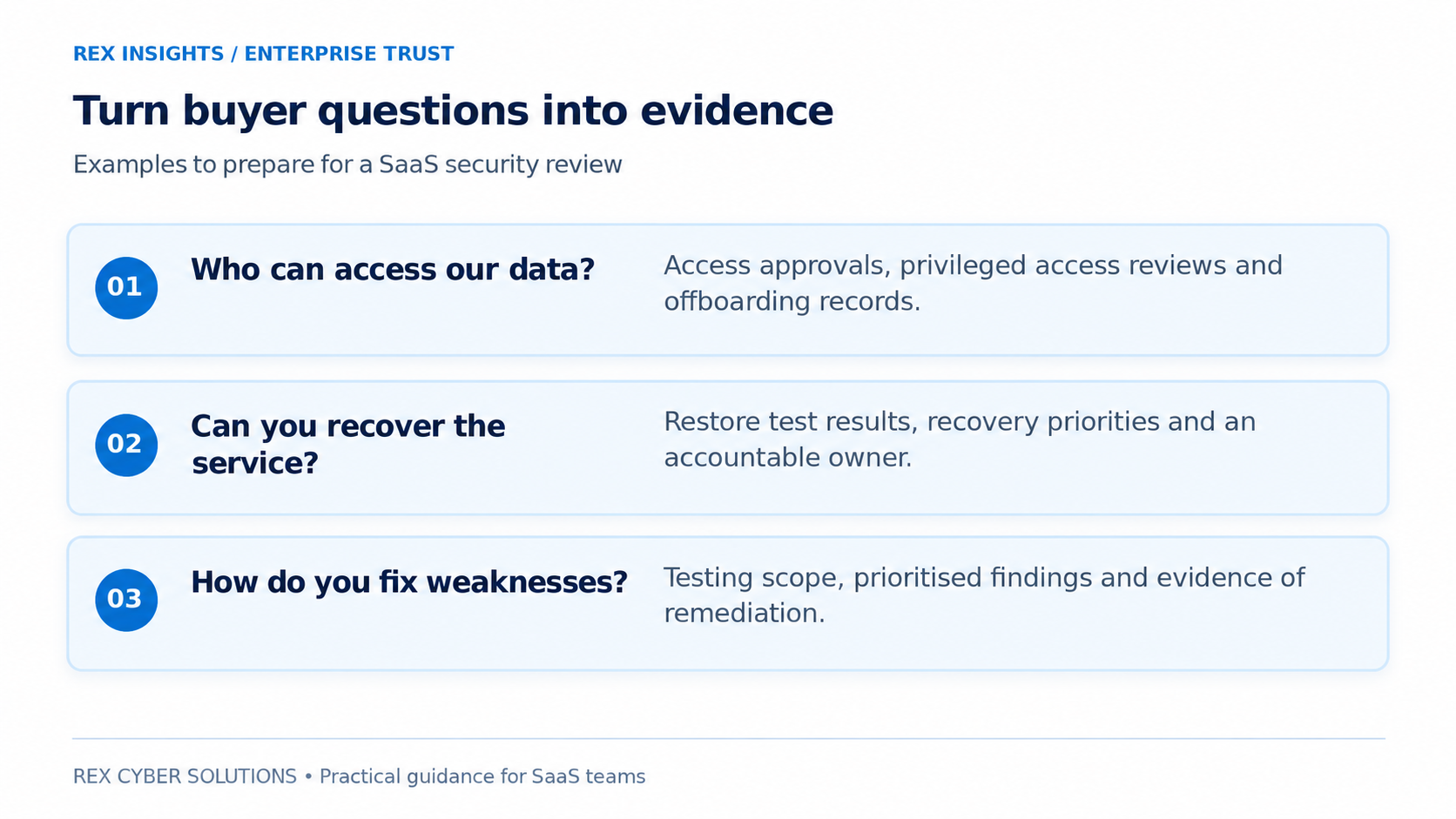
Examples of buyer questions and records a SaaS team can prepare. The buyer may request additional evidence.
2. What ISO 27001 means for a SaaS company
ISO/IEC 27001:2022 sets requirements for an information security management system, or ISMS. It brings people, processes and technology into a risk-based approach to protecting information and continually improving security. Organisations of different sizes can use it.
Certification involves an independent certification body. ISO develops standards and does not issue certificates itself. A certificate concerns the defined ISMS scope; check that scope before describing what your certification covers.
For your SaaS team, start with a practical boundary: which service is being assessed, which teams operate it and which systems support it? Include a clear explanation of dependencies such as cloud hosting, identity services and outsourced support. Avoid sales wording that suggests every product or business unit is covered when the scope is narrower.
Certification also does not establish that a product has no vulnerabilities or that every buyer requirement is satisfied. Keep technical testing and customer-specific review questions in the conversation.
Need help defining scope and understanding your gaps? Explore Rex’s ISO 27001 compliance services
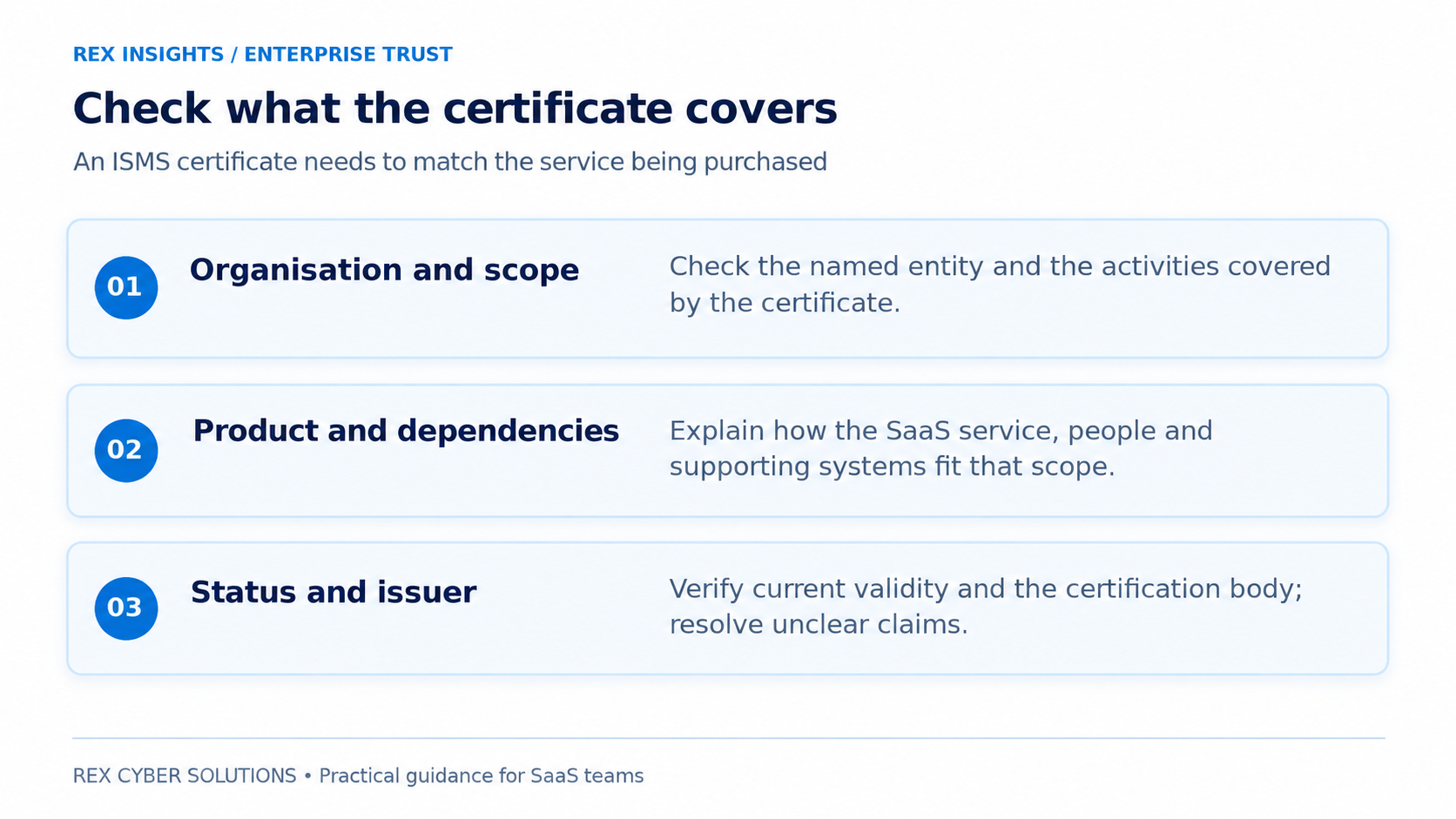
Use these checks when preparing a certificate for a buyer’s review. Resolve scope questions before making claims.
3. Five questions to prepare for before the next deal
3.1 Who can access customer information?
Prepare an explanation of employee, contractor and support access. Show how privileged access is approved, reviewed and removed. For a multi-tenant application, explain how tenant boundaries are enforced and how support access is controlled. An access review record is more useful than a broad assurance that everyone follows policy.
3.2 How do you identify and fix weaknesses?
Be ready to explain what was tested, when it was tested and what happened to the findings. A report from an older product version may not address a new API or changed authorisation flow. Track remediation and retesting where appropriate, and disclose relevant unresolved issues through an agreed channel.
If you need evidence about application weaknesses and their impact, Review Rex’s web application penetration testing services
3.3 What happens if the service goes down?
Discuss recovery in terms the buyer understands: which functions return first, who coordinates the response and what has been tested. Separate a planned recovery target from a demonstrated result. Keep restore test records and explain any important dependencies that could affect recovery.
3.4 Which suppliers support the service?
Map the providers that host, process or support customer information. Decide who reviews supplier risks and monitors material changes. A provider’s certificate can inform that review, but your team still needs to explain its own configuration, permissions and use of the service.
For technical testing of your cloud environment, Explore Rex’s cloud penetration testing services
3.5 Who responds when something goes wrong?
Prepare named owners, escalation routes and an incident communication process. Check that contractual promises can actually be supported by your team. Use a realistic exercise to test handoffs between engineering, security, customer success and leadership before a live incident puts them under pressure.
4. Build a security evidence pack your team can maintain
Create a controlled set of reusable security answers rather than starting each questionnaire from a blank page. This is a practical operating recommendation: the exact contents should follow your service, risks and buyer requirements.
For each answer, record the owner, last review date and supporting evidence. Useful material may include a scope description, an architecture overview, approved security policies, access review records, testing summaries, supplier reviews and recovery test results. If certified, include the current certificate and its scope.
Keep claims precise. If a control is planned, label it as planned. If a control applies only to part of the service, explain the boundary. Ask a technical owner to review material answers before sales sends them, especially after significant product or infrastructure changes.
Share information proportionately. A buyer may need a redacted testing summary before a full technical report. Agree the recipient, purpose and sharing conditions, and remove secrets, personal information and details the reviewer does not need.
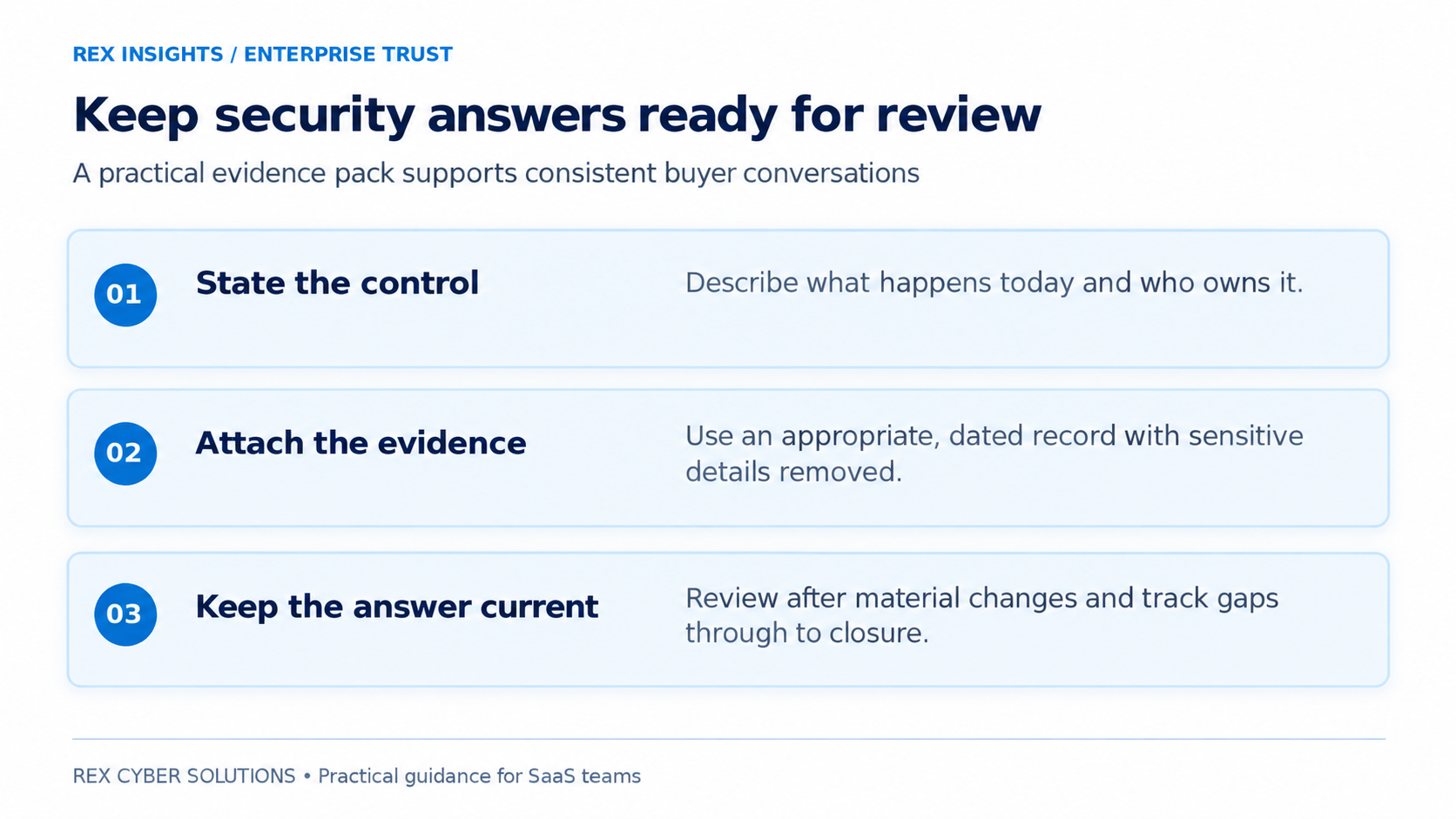
A repeatable way to maintain buyer-facing answers. Evidence should reflect the service as it operates today.
If a buyer requires certification and you are still preparing, say so. Agree what interim evidence the buyer will consider and what remains a contractual condition. An internal assessment or planned audit is not an issued certificate.
Need a clearer starting point? Rex offers gap assessment, risk assessment, documentation and audit preparation support. Start with Rex’s ISO 27001 readiness support
5. Seven questions for SaaS leadership
Before describing the company as ready for enterprise security review, work through these questions with the people responsible for delivery.
1. Have we confirmed what our target buyers require and when they need it?
2. Does our proposed or certified scope match the SaaS service we are selling?
3. Can an accountable owner explain each important security answer?
4. Do we have recent evidence for access, testing, recovery and supplier oversight?
5. Are unresolved risks visible, with decisions and remediation owners recorded?
6. Have sales and technical teams agreed what we can accurately promise?
7. Who will keep the evidence and answers current after this deal closes?
Use the answers to assign work and priorities. A completed questionnaire is only useful if your team can support its statements when the buyer asks a follow-up question.
6. Frequently asked questions
Q1. Is ISO 27001 mandatory for every SaaS company?
Answer: Certification is a choice under the standard. A particular buyer or contract may require it. Ask your target customers what assurance they accept before deciding the scope and priority of your certification work.
Q2. Will certification remove security questionnaires?
Answer: Do not plan on that. Buyers can still ask about your product, architecture, testing, data handling and contractual commitments. Prepare a reusable evidence pack so that those answers are easier to maintain.
Q3. Are we covered by our cloud provider’s certification?
Answer: Your provider’s certificate relates to its own defined scope. Explain which responsibilities it covers and which remain with your company. Your application, access arrangements and operating processes need their own assessment.
Q4. Is a penetration test enough to become ISO 27001 certified?
Answer: A penetration test can provide valuable technical evidence, but it does not certify an ISMS. Use findings to improve the service and inform risk decisions alongside the wider preparation work.
Q5. How long does ISO 27001 certification take?
Answer: There is no reliable one-size-fits-all estimate for your company. Scope, existing practices, remediation work, evidence availability and the certification body’s schedule all affect the plan. Get a readiness assessment before committing a date to a buyer.
Q6. Can Rex issue our ISO certificate?
Answer: Rex’s service is compliance and certification preparation support, including liaison with the certifying body. Certification is performed by an independent certification body. Keep implementation support and the certification decision distinct when planning the engagement.
7. Prepare for your next enterprise security review
Enterprise trust becomes easier to explain when your security answers have owners, evidence and clear boundaries. ISO 27001 gives that work a recognised management framework. Its commercial value depends on how well the programme reflects your service and the expectations of the buyers you want to serve.
Rex Cyber Solutions supports SaaS teams with ISO 27001 gap assessments, risk and control mapping, ISMS documentation, internal audit and management review preparation, and audit closure support. Start with the questions holding up your next buyer conversation and identify the work needed to answer them confidently.
Use a discovery call to understand your readiness gaps, identify what to fix first and get answers to your questions. Bring the buyer’s questionnaire or certification requirement so the discussion can focus on your company’s needs.
Book an ISO 27001 readiness call with Rex
Prefer to review the service first? View Rex’s ISO 27001 compliance services