

Why Mid-Market Indian Enterprises Are Considering a Managed SOC for SOC 2 Compliance
By Rex Cyber Solutions
An enterprise customer asks for a SOC 2 report before renewing a contract. Your IT team already manages cloud infrastructure, employee access and production support. It also receives security alerts—but investigation depends on who is available, and the evidence is spread across inboxes, dashboards and tickets.
For a growing Indian service business, that is a practical reason to consider a managed Security Operations Centre, or SOC. The service can add monitoring capacity, a repeatable response process and better records of what happened. Its value depends on the coverage and responsibilities actually included in the contract.
This article explains the business case for that shift, rather than claiming a measured India-wide adoption trend. A managed SOC can support SOC 2 readiness, but buying one is neither a mandatory SOC 2 requirement nor a guarantee of a favourable audit opinion.
In this article
1. Managed SOC and SOC 2 are different things
2. Why the model can fit mid-market Indian enterprises
3. Where monitoring supports SOC 2 readiness
4. What stays with your internal team
5. How to assess a managed SOC proposal
6. Build the evidence process before the examination
7. Frequently asked questions
8. Discuss your SOC 2 readiness with Rex
1. Managed SOC and SOC 2 are different things
A Security Operations Centre is an operational capability for detecting, investigating and responding to security events. A managed SOC delivers agreed parts of that capability through an external provider. It may combine analysts, detection technology and response support; confirm the actual service boundaries.
SOC 2 means System and Organization Controls 2. It is an independent CPA examination and report about controls relevant to the scoped service organisation system. The Trust Services categories cover security, availability, processing integrity, confidentiality and privacy. Agree the relevant scope with the auditor. [1]
Although buyers often search for “SOC 2 compliance” or “SOC2 certification”, the formal deliverable is an attestation report. A monitoring vendor does not issue that report merely by providing a dashboard or a security service.
Type 1 and Type 2 answer different questions
A Type 1 report addresses the system description and control design at a specified date. A Type 2 report additionally addresses operating effectiveness over a specified period. Confirm the report type and period your customer needs before choosing a readiness plan. [1]
SOC 1 and SOC 2 are different report families; SOC 1 concerns controls relevant to customers’ financial reporting. “SOC I and SOC II” can therefore be ambiguous. Specify “SOC 2 Type 1” or “SOC 2 Type 2” in procurement documents. Terms such as “2 SOC” and “SOC 2.0 compliance” should not substitute for the exact report requested.
Start by defining the right scope: Explore Rex’s SOC 2 readiness services
2. Why the model can fit mid-market Indian enterprises
Customer expectations can outgrow internal coverage
A business serving overseas customers may operate across several time zones while its security team works a narrower schedule. If an important alert arrives overnight, the response depends on the coverage model. A managed service can help close that gap when investigation, escalation and response availability are explicitly contracted.
Ask what “24/7” covers. Continuous log collection is different from continuous analyst investigation. An analyst watching alerts is also different from a responder authorised to disable an account or isolate a device. The proposal should describe each activity and its service level.
Specialist capacity is more than a headcount
Building internally involves recruitment, shift coverage, leave, training, detection engineering and supervision. A managed arrangement can provide access to a broader team, but it still requires an internal owner who understands the business and can approve action. Compare the full operating model rather than a vendor fee against one employee’s salary.
Evidence needs to survive staff changes
An alert resolved in a private chat is difficult to explain months later. A consistent case record makes the investigation reusable for management review, customer assurance and audit requests. Define the evidence format at onboarding so the organisation can access it even when personnel or suppliers change.
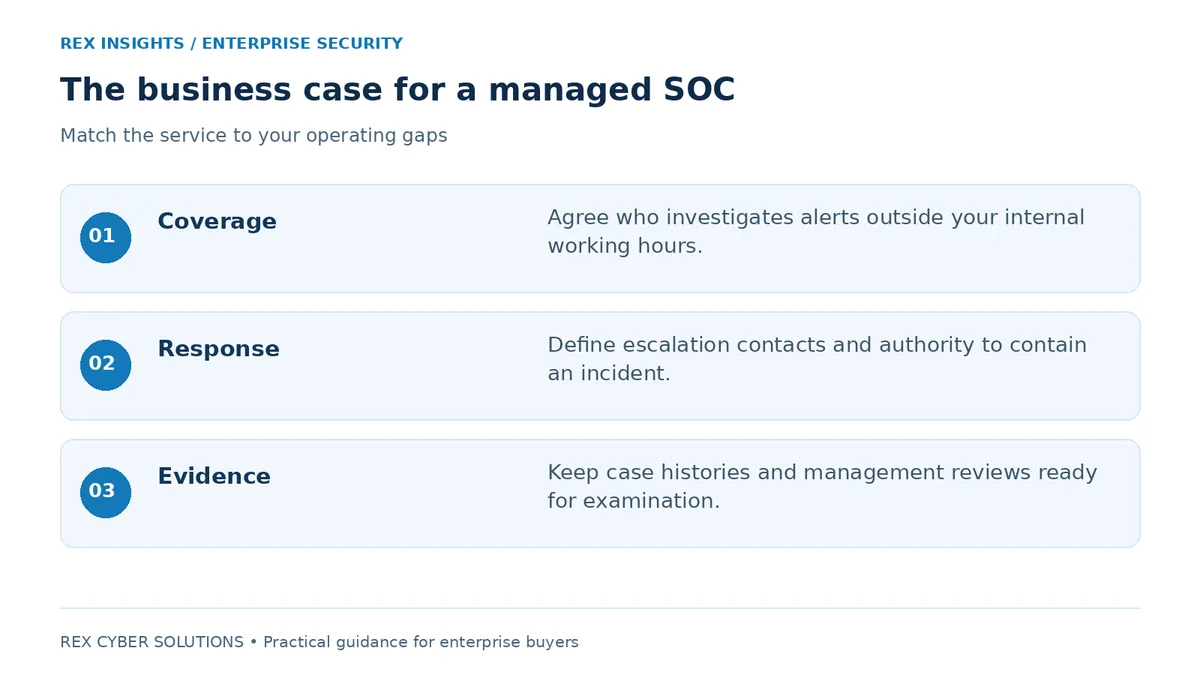
Evaluate coverage, response and evidence together. The service name alone does not establish any of them.
3. Where monitoring supports SOC 2 readiness
The AICPA’s system operations criteria address vulnerability and configuration detection, monitoring anomalies, evaluating security events, responding to incidents and recovery. These are areas where a properly scoped managed service can contribute. The mapping below is practical implementation guidance, not a complete control catalogue or an auditor’s conclusion. [2]
Monitoring relevant systems
Begin with the systems that support the service under examination. Identity events, endpoint signals, cloud activity and application logs may each provide different visibility. Record which sources are connected, which are excluded and how failures in collection are detected. A polished dashboard can still hide an unmonitored production account.
Investigating and escalating events
Ask analysts to record why an event was closed, escalated or treated as an incident. Preserve the supporting evidence and the sequence of decisions. An unexplained “false positive” label gives the next reviewer little to work with and makes recurring problems harder to identify.
Following response through to closure
A useful case links detection to the business owner’s response. If a suspicious account is disabled, record the approval, action and validation. If remediation is delayed, record who accepted the temporary exposure and when it will be reviewed. Investigation and patch deployment may belong to different teams; make the handover explicit.
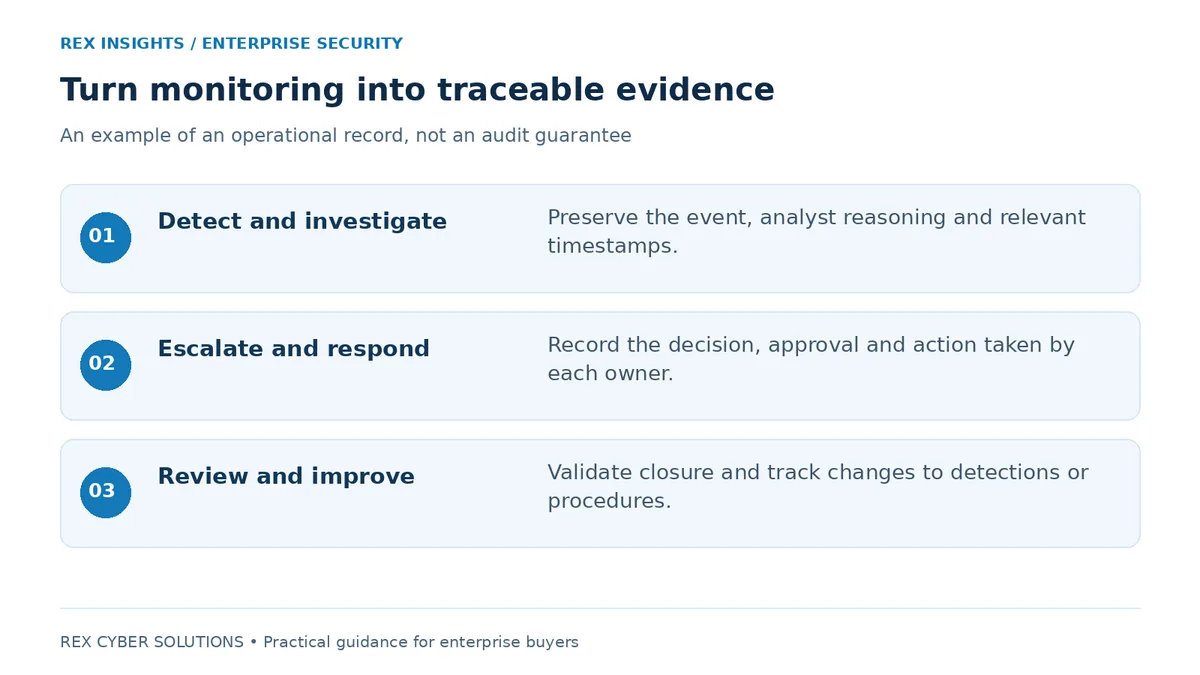
Example evidence chain: event, investigation, decision, response and review.
Consider a hypothetical alert involving a privileged cloud account outside its usual pattern. The analyst checks context, contacts the nominated responder and records the outcome. Your team approves containment and verifies access restoration. The record should show that sequence, including any delay. This example illustrates process evidence; it is not a claim that every service includes these actions.
4. What stays with your internal team
Management still needs to understand the risks and oversee the service. A supplier can perform agreed tasks, but your organisation must decide whether the resulting controls fit its commitments to customers.
Keep named internal owners for access approvals, joiner and leaver processes, secure development, change management, supplier reviews, continuity planning and remediation. A managed SOC contract may contribute to some of these activities, but it rarely covers the entire readiness programme.
Monitoring also does not replace a vulnerability assessment or penetration test. Detection looks for relevant events and suspicious behaviour; testing can expose weaknesses that have not yet produced an alert. Use each activity for its purpose and connect findings to the same remediation process.
If infrastructure weaknesses remain unclear, Review Rex’s network vulnerability assessment service
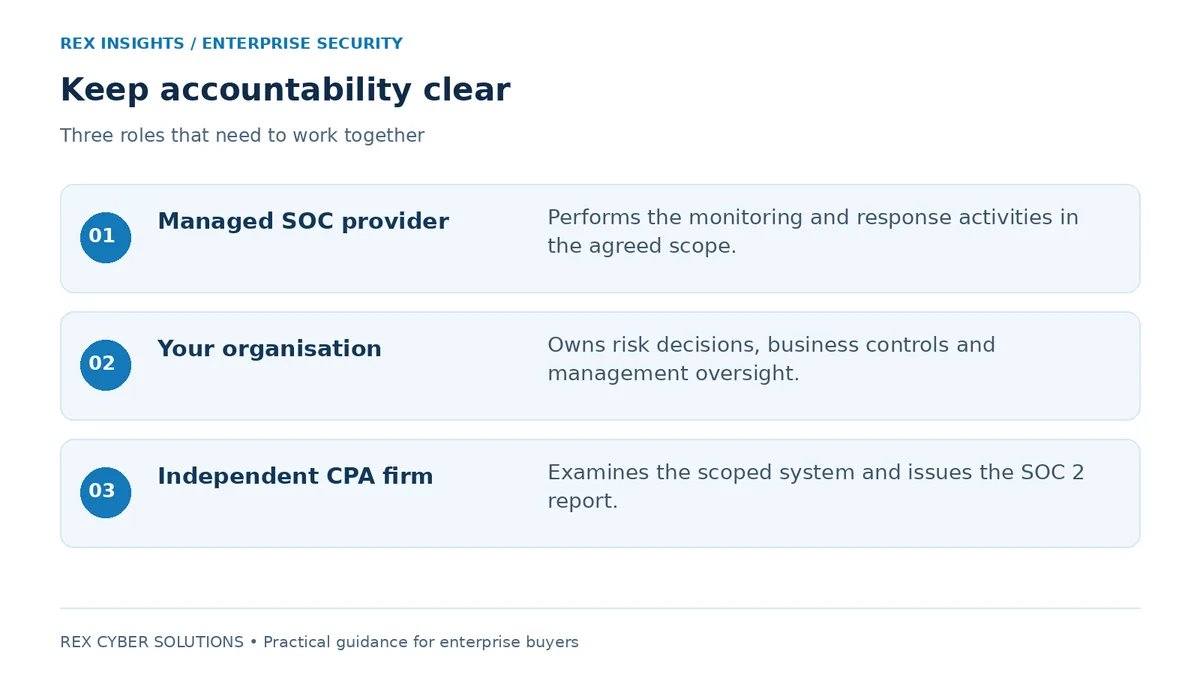
Operational support, management accountability and independent examination have distinct roles.
5. How to assess a managed SOC proposal
Before signing, ask the provider to walk through one realistic incident using your environment. The answers should be specific enough to become contract commitments.
1. Coverage: Which endpoints, identities, applications and cloud accounts are included? How are missing or disconnected log sources reported?
2. Investigation: Who reviews alerts, during which hours, and what does the response target actually measure?
3. Authority: Which actions can analysts take immediately, which require approval and who answers when the primary contact is unavailable?
4. Evidence access: Can you export case histories, timestamps and supporting records? What happens to them at contract exit?
5. Data handling: Where are logs stored, who can access them and which subcontractors are involved? Agree retention and access controls for the data collected.
6. Vulnerability ownership: Does the fee include scanning, validation, remediation tracking or retesting? Who actually deploys fixes?
7. Commercial limits: What changes the price: asset count, ingestion volume, retention, integrations, response hours or incident work?
8. Assurance support: What evidence will be provided to your auditor, and what assistance is excluded? Avoid promises of guaranteed audit outcomes.
A low monthly price can become expensive when key integrations or response work sit outside scope. Equally, a higher fee does not demonstrate better coverage. Compare providers against the same inventory, operating hours and responsibilities.
6. Build the evidence process before the examination
Start with the service boundary and customer requirement. Bring the internal control owner, readiness team, managed provider and independent auditor into the planning process early enough to align evidence expectations.
1. Document the systems and responsibilities included in scope.
2. Connect the agreed sources and test whether events actually arrive.
3. Exercise escalation and containment with a realistic scenario.
4. Review evidence quality, unresolved cases and monitoring gaps regularly.
5. Retain records across the agreed examination period and track changes to the service.
Use management reviews to examine exceptions as well as activity totals. Useful measures include missing log sources, unresolved high-priority cases, delayed escalations and repeat incidents. State how each metric is calculated. A faster average response time can conceal a small number of serious delays.
AICPA published proposed 2027 criteria for comment in October 2026. A proposal is not a final replacement standard. Confirm the applicable criteria and any eventual transition arrangements with the CPA firm responsible for your engagement. [1]
7. Frequently asked questions
Q1. Is a managed SOC compulsory for SOC 2?
Answer: No. Choose controls and an operating model appropriate to the scoped system. Internal, managed and shared arrangements can be considered; the organisation needs evidence that its chosen controls operate as described.
Q2. Will a managed SOC give us SOC2 certification?
Answer: No. The managed provider supplies contracted security services. An independent CPA firm performs the SOC 2 examination and issues the report.
Q3. Does the provider’s own SOC 2 report cover our company?
Answer: No. It can inform your supplier review, but its scope and controls belong to that provider’s reported system. Your own service and responsibilities need separate assessment.
Q4. Can we obtain Type 2 immediately after onboarding?
Answer: Onboarding does not create a historical operating record. Agree the examination period and evidence expectations with your auditor; do not assume a newly connected tool proves earlier control operation.
Q5. Will this also establish DPDP compliance?
Answer: No. SOC 2 assurance and statutory data protection obligations are separate. Operational evidence may be useful across programmes, but privacy responsibilities require their own applicability and gap review.
Q6. When is a managed SOC worth evaluating?
Answer: When your team has defined gaps in coverage, investigation capacity, response coordination or evidence retention. Start with those gaps, then compare a managed arrangement with strengthening the internal team.
8. Discuss your SOC 2 readiness with Rex
Before buying another security tool or signing a monitoring contract, identify what your SOC 2 programme actually needs. A readiness review can separate missing controls from missing evidence, unclear ownership and insufficient operating coverage.
Rex Cyber Solutions offers SOC 2 gap assessment, control documentation, evidence collection and auditor coordination support. Discuss your system boundary, existing security tools, customer requirements and internal capacity so the engagement can address the right gaps.
Bring your current monitoring scope, incident process and recent vulnerability findings to the conversation. Ask which activities should stay internal, which need specialist support and how the evidence will reach your auditor. Agree any managed monitoring capability, service levels and exclusions explicitly in the proposal.
Request a SOC 2 readiness discussion with Rex
Book a discovery call with the Rex team