Why Securing Individual Layers Doesn’t Secure the System
Introduction
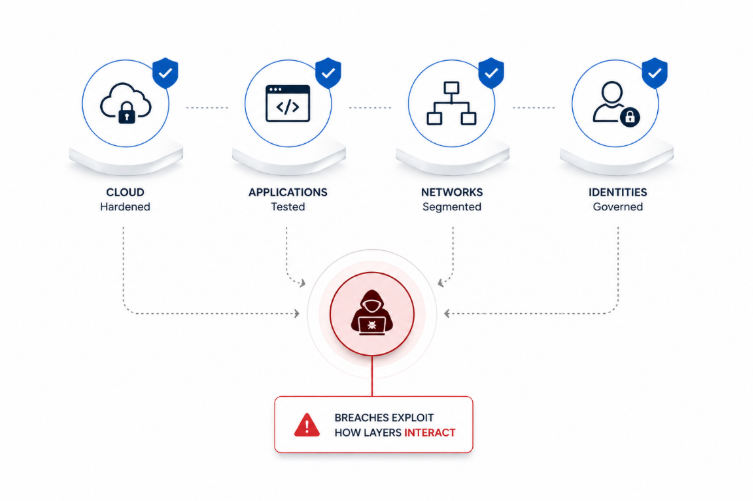
Modern organizations don’t lack security controls. They lack system-level validation. Cloud environments are hardened. Applications undergo testing. Networks are segmented. Identities are governed. Individually, each layer appears secure. But breaches rarely exploit a single layer in isolation. They exploit how these layers interact.
The Illusion of Layered Security
Security programs are typically structured around domains:
Each function operates with its own tools, metrics, and validation methods.
From a governance perspective, this looks complete. From an attacker’s perspective, it is fragmented. Because attackers do not operate within organizational boundaries. They move across layers, following whatever path the environment allows. The problem is not that layers are insecure. The problem is that no one validates how they behave together.
Where Layered Security Breaks in Practice
1. Access Chains That Span Multiple Layers
Consider a common enterprise setup:
Each component may be individually secured.
But what happens when access flows across them?
These are not vulnerabilities in a single layer. They are failures in how access propagates across layers.
2. Implicit Trust Between Systems
Modern architectures depend heavily on trust relationships:
This trust is necessary for functionality.
But it is rarely validated under adversarial conditions.
Once an attacker gains a foothold, they do not need to break every control.
They need to find one trusted path and follow it.
And because that path is “legitimate,” it often goes undetected.
3. Security Controls That Work Individually but Fail Collectively
Security controls are typically validated in isolation:
Each control passes its own test.
But real-world scenarios do not respect these boundaries.
For example:
An attacker does not need to bypass all controls.
They need to operate within the gaps between them.
4. Fragmented Testing Approaches
Most organizations test security through:
Each assessment provides value.
But they rarely simulate cross-layer movement.
This creates a false sense of assurance:
But no one has validated:
Can an attacker move from one layer to another?
That is where real risk exists.
How Attackers Actually Exploit Systems
Attackers do not think in terms of:
They think in terms of reachability.
Their objective is simple:
“Given one point of access, what else can I reach?”
A typical attack path may look like:
At no point is a single control necessarily “broken.”
Instead, the system behaves in a way that allows movement.
This is why traditional testing often misses real-world scenarios.
Because it validates components, not paths.
The Shift: From Layers to Systems
To address this gap, organizations need to shift from:
“Are individual layers secure?”
to
“How does the system behave under real-world conditions?”
This requires a fundamentally different approach.
1. Testing Access Flows, Not Just Endpoints
Instead of validating isolated endpoints:
This reveals how small permissions become large exposures.
2. Mapping Reachability Across the Environment
Security should focus on:
This is not asset inventory.
It is exposure mapping.
3. Validating Trust Relationships
Every trust assumption should be tested:
Trust should not be assumed.
It should be continuously verified.
4. Simulating Real Attack Paths
Effective security testing should answer:
This requires moving beyond checklists.
It requires thinking like an attacker.
What This Means for Leadership
For CXOs and CISOs, this is not just a technical issue.
It is a risk visibility problem.
Most leadership dashboards show:
But these do not answer the most critical question:
If one system is compromised, how far does the impact spread?
Without this visibility:
Because security is being measured in isolation.
While risk exists in interaction.
Why This Gap Is Increasing
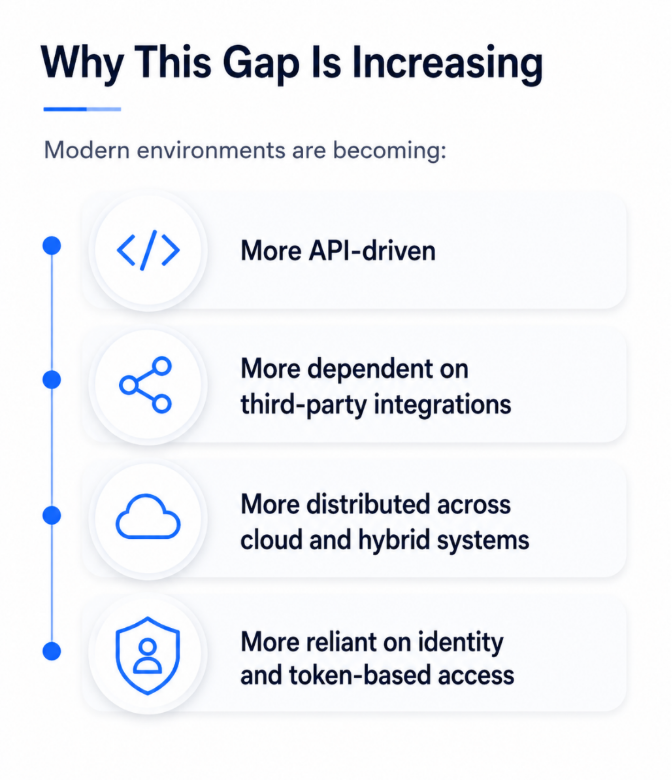
This challenge is not static. It is accelerating.
Modern environments are becoming:
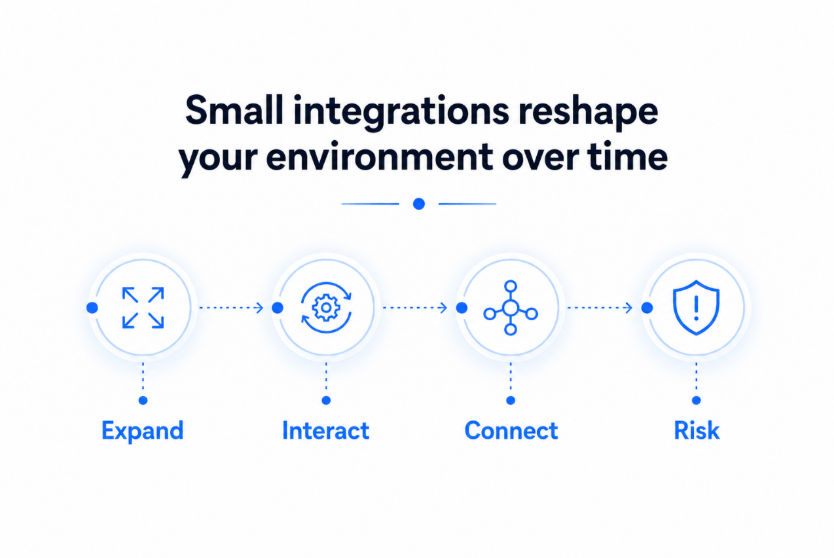
Every new integration adds functionality.
It also adds new paths.
And these paths are rarely tested end-to-end.
From Protection to Validation
Traditional security focuses on protection:
But modern security must focus on validation:
Because attackers do not always break systems.
They use them as designed in ways that were never intended.
Final Thought: The System Is the Risk
Nothing may appear broken. Every control may be in place. Every audit may be passed. Every layer may be secured. But the system may still be exposed.
Because risk is no longer defined by:
It is defined by:
What can be reached when everything connects
And that is what most organizations never fully test.
Frequently Asked Questions (FAQs)
1. Why is securing individual layers not enough in modern cybersecurity?
Securing individual layers such as cloud, applications, or networks only ensures that each component meets its own security requirements. However, modern attacks exploit how these layers interact. If access, identity, and data flows are not validated across layers, attackers can move between systems without breaking any single control. The real risk lies in how systems behave together, not in how they are secured individually.
2. What is the difference between layered security and system-level security?
Layered security focuses on protecting individual domains (e.g., network, application, cloud), while system-level security evaluates how these domains interact in real-world scenarios. System-level security identifies attack paths, access chains, and trust relationships that exist across layers, which are often missed in isolated testing approaches.
3. How do attackers exploit gaps between security layers?
Attackers rarely target a single vulnerability. Instead, they:
This allows them to move laterally and access sensitive data without triggering traditional security controls.
4. What is attack path or reachability analysis in cybersecurity?
Attack path analysis focuses on identifying what an attacker can reach from a given entry point. Instead of listing vulnerabilities, it maps how access can expand across systems, APIs, identities, and data stores. This approach helps organizations understand real-world exposure by evaluating connectivity and access flow, not just individual weaknesses.
5. How can organizations validate security across the entire system?
Organizations should move beyond isolated testing and adopt approaches that:
This ensures that security controls are not only present but also effective under realistic conditions.

%20(1).png)
.png)

.png)